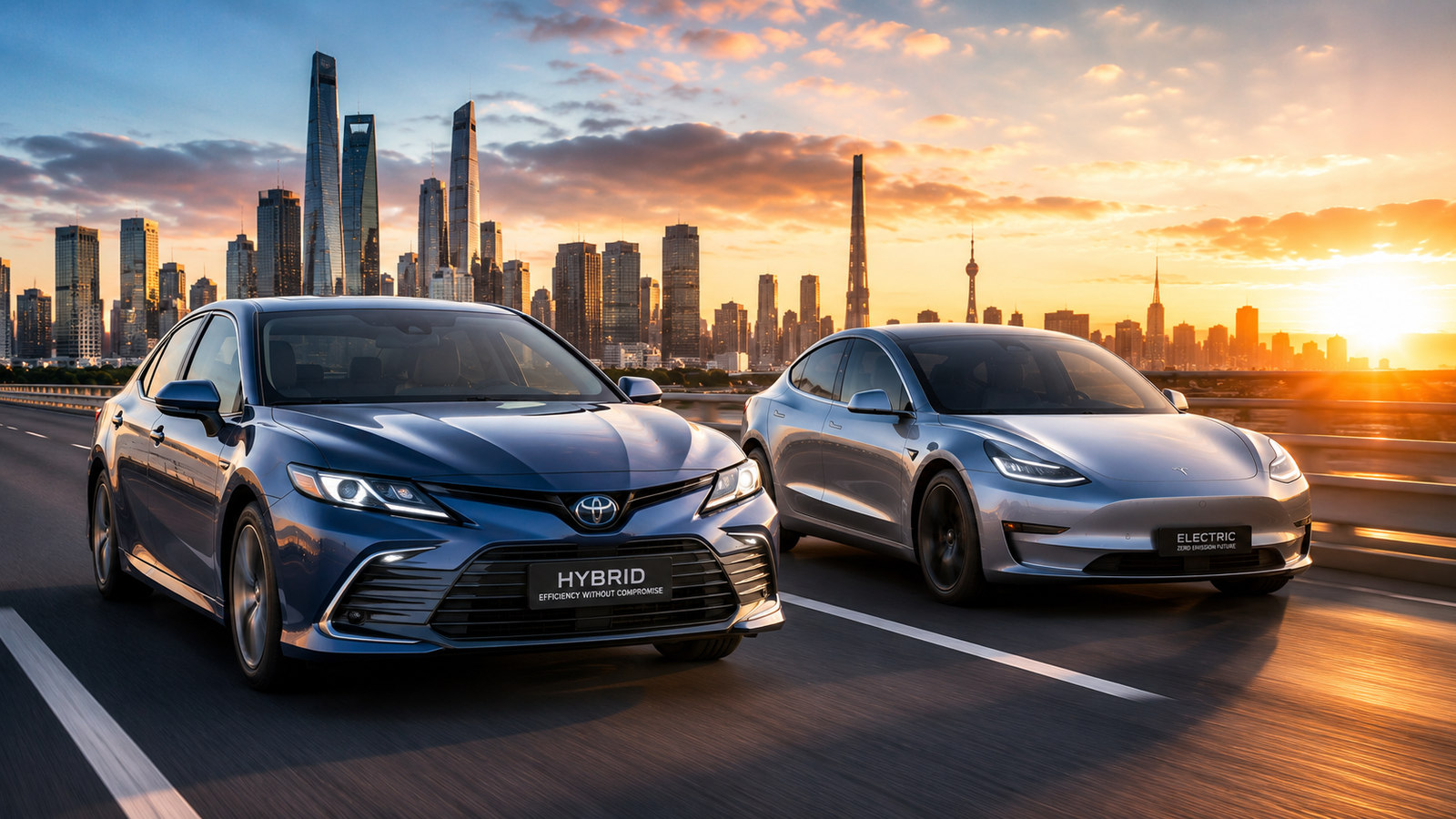
Why Hybrid Cars Are Suddenly Looking Smarter Than EVs
Could the hybrid car be the unexpected winner of the EV revolution?
For years, the message seemed simple: if you wanted the future of driving, you bought an EV.
But 2026 is making that decision a lot less obvious.
Electric cars aren't disappearing. Far from it. Global EV sales passed 20 million in 2025, representing roughly one in four new cars sold worldwide. Yet at the same time, hybrids are attracting buyers who want better fuel economy without making charging part of their daily routine.
And that's where things get interesting.
The question isn't really “Are EVs dead?” They aren't.
The better question is: Have hybrids found the sweet spot between gasoline convenience and electric efficiency?
For a growing number of drivers, the answer might be yes.
1. Why Are Hybrids Suddenly Getting So Much Attention?
Here's the part that would've sounded strange a few years ago: some drivers who were considering an EV are taking another look at hybrids.
In the United States, hybrids reached a record 16% of new light-duty vehicle sales in the second quarter of 2026, according to the U.S. Energy Information Administration. Battery-electric vehicles represented 6% during the same period.
That's a pretty dramatic difference.
A hybrid doesn't ask you to completely change your routine.
You still visit a gas station. You don't need to plan a long road trip around charging stops. And if your home doesn't have convenient parking or charging access, you don't have to solve that problem before buying the car.
Think of a hybrid as a bridge.
The gasoline engine handles the situations where you need range and quick refueling, while the electric motor helps the vehicle use less fuel, particularly in stop-and-go driving.
The result is a car that feels familiar but borrows some of the efficiency tricks of an EV.
And for many buyers, that combination is becoming difficult to ignore.
2. The Charging Question Is Bigger Than It Sounds
But here's where the EV conversation gets personal.
Charging is incredibly convenient if you have convenient charging.
If you have a garage, reliable electricity and a suitable home charger, plugging in overnight can be easier than visiting a fuel station.
But what happens if you live in an apartment?
What if your parking space isn't near an electrical connection?
What if you regularly travel long distances and don't want another variable in the journey?
Research published in 2026 found that people living in rental homes and homes with inadequate parking are less likely to adopt battery-electric vehicles, while they are more likely to choose plug-in hybrids. The researchers also found that home-charger installation can become more expensive when electrical upgrades are required.
That's an important distinction.
The EV itself may be excellent. The problem can simply be the environment around it.
A hybrid largely sidesteps that issue.
You fill it with gasoline and drive away.
No waiting. No charger hunting. No worrying about whether the hotel you're staying at has a working charging point.
That doesn't make hybrids technologically superior to EVs.
It makes them easier to live with for certain lifestyles.
3. Taiwan Offers a Fascinating Clue
And then there's Taiwan.
The country's vehicle market gives us a particularly interesting glimpse at how consumer preferences can shift when EV adoption doesn't move in a straight line.
According to Taiwan's Automotive Research & Testing Center, the country's BEV registrations reached 32,551 vehicles in 2025, down about 14.5% from 2024. BEVs still represented roughly 8.1% of new passenger and light-commercial vehicle registrations.
Meanwhile, hybrid demand has been moving in the opposite direction.
A February 2026 report based on Taiwan registration data said annual hybrid sales climbed from 59,050 in 2021 to 129,429 in 2025, more than doubling in five years. Electrified vehicles—including hybrids, plug-in hybrids and BEVs—reached 165,555 units in 2025.
That's not a tiny niche anymore.
There's another revealing detail.
In July 2026, Hotai Motor said demand for Toyota's hybrid vehicles, including the RAV4, was strong enough that supply was becoming a limitation. The company said hybrid and electric vehicles accounted for nearly half of Toyota and Lexus sales in Taiwan.
So what's happening?
Taiwan isn't proving that hybrids will defeat EVs everywhere. Markets don't work that neatly.
But it does show something important: when buyers want electrification without giving up familiar refueling convenience, hybrids can become an extremely attractive middle ground.
And sometimes the middle ground is exactly where the biggest opportunity is.
4. Hybrid vs EV: Which One Actually Makes More Sense?
Let's make the choice simpler.
Feature | Hybrid (HEV) | Battery EV (BEV) |
|---|---|---|
Gasoline needed | Yes | No |
Home charging required | No | Highly useful |
Long-distance convenience | Excellent | Depends on charging network |
Refueling | Usually a few minutes | Charging takes longer |
Tailpipe emissions | Yes | None while driving |
Fuel economy | Much better than conventional cars | No gasoline consumption |
Mechanical complexity | Higher than BEV | Generally fewer moving parts |
Best for | Mixed driving & convenience | Drivers with reliable charging |
Road-trip planning | Usually simple | Charging may need planning |
The interesting thing is that neither powertrain wins every category.
An EV has a major advantage in efficiency and can be wonderfully simple to drive.
There's no oil change in the traditional sense, no conventional transmission and no gasoline engine constantly firing up.
But a hybrid has one enormous advantage:
You don't have to reorganize your life around it.
That matters more than some car enthusiasts like to admit.
If you're someone who drives 20 miles to work, charges at home every night and rarely travels far, an EV can make tremendous sense.
But if you live somewhere without convenient charging, regularly drive 500 miles in a weekend, or simply don't want to think about charging, the calculation changes.
That's where the hybrid starts looking pretty clever.
5. Here's the Twist: EVs Aren't Actually Losing
Now for the part that could completely change the headline.
Hybrid momentum doesn't mean the EV revolution has failed.
The global numbers tell a very different story.
The International Energy Agency says electric-car sales exceeded 20 million globally in 2025, growing 20% year over year. Electric cars represented about 25% of all new-car sales worldwide.
The IEA also expects global electric-car sales to rise to around 23 million in 2026, potentially representing about 28% of total car sales.
So why are hybrids suddenly receiving so much attention?
Because the automotive market isn't choosing one technology overnight.
It's becoming more complicated.
EVs are expanding.
Hybrids are expanding.
Plug-in hybrids are evolving.
Extended-range EVs are appearing.
Automakers are essentially testing multiple answers to the same question:
How do we reduce fuel consumption without making the car harder to live with?
And that question has no single answer.
In fact, the IEA says hybrid model availability increased by more than 10% year over year in 2025, reaching more than 200 models worldwide.
That's a lot more choice than the average buyer had a few years ago.
6. The Real Winner Might Be the Driver Who Has Options
Here's what I think is the most interesting part.
The future probably won't be “hybrids replace EVs.”
It may be something much messier—and much more realistic.
Different drivers will choose different powertrains.
Someone living in a house with solar panels and overnight charging may wonder why anyone still buys gasoline.
Someone living in an apartment may wonder why anyone would voluntarily depend on a charging network.
A city commuter may love an EV.
A salesperson covering hundreds of miles every week may prefer a hybrid.
A family that takes occasional long road trips might choose a plug-in hybrid.
None of those choices is automatically wrong.
And that's why the hybrid comeback matters.
The hybrid isn't necessarily winning because it's better technology.
It's winning because it solves a very human problem:
People want better efficiency, but they don't always want a completely different driving routine.
That distinction could shape the automotive market for years.
So, Have Hybrids Temporarily Beaten EVs?
Maybe—in one very specific sense.
They may have beaten EVs at being the easy transition technology.
But globally, EVs are still growing rapidly. The IEA's latest data makes that clear.
The more likely future isn't a war where one technology destroys the other.
It's a garage containing several different answers.
EVs for people who can charge easily.
Hybrids for people who want efficiency without charging.
Plug-in hybrids for people who want a little of both.
And conventional engines may remain around in some markets for longer than many predicted.
The automotive industry's next chapter might not belong to one technology.
It might belong to choice.
And honestly, that's probably better for buyers.
❓ FAQs
1. Are hybrid cars better than EVs?
Not universally. EVs can be more efficient and have zero tailpipe emissions, while hybrids can be more convenient for drivers who lack reliable charging access or frequently travel long distances.
2. Why are hybrid cars becoming popular again?
Hybrids combine an electric motor with a gasoline engine, giving drivers improved fuel economy without requiring them to depend on charging infrastructure.
3. Are EV sales declining in 2026?
EV growth has varied by market, but globally EV sales remain strong. The IEA expects approximately 23 million electric-car sales in 2026.
4. Are hybrid cars cheaper to run than gasoline cars?
They can use substantially less fuel than comparable conventional vehicles, particularly in urban and stop-and-go driving. Actual savings depend on the vehicle, fuel prices and driving habits.
5. Will hybrids replace electric cars?
Probably not. Hybrids and EVs are likely to coexist, with each technology fitting different driving patterns, charging situations and markets.
🏁 Conclusion: The Hybrid Comeback Is More Important Than It Looks
For years, the automotive industry made the transition to electric cars sound almost inevitable—and eventually, it may be. But the road to that future isn't as straight as it once appeared.
Hybrids are proving that buyers still value something incredibly simple: convenience.
The latest U.S. sales data shows hybrids reaching a record 16% share of new light-duty sales, while Taiwan's rapidly growing hybrid market shows how strong demand can become when consumers want electrification without completely changing their routines.
EVs aren't going away. They're growing too.
Maybe the real winner isn't hybrid or electric.
Maybe it's the driver who picks the technology that actually fits their life.
Would you choose a hybrid, a full EV, or something in between for your next car—and why?
Leave a Comment
Your comment will appear after moderation.