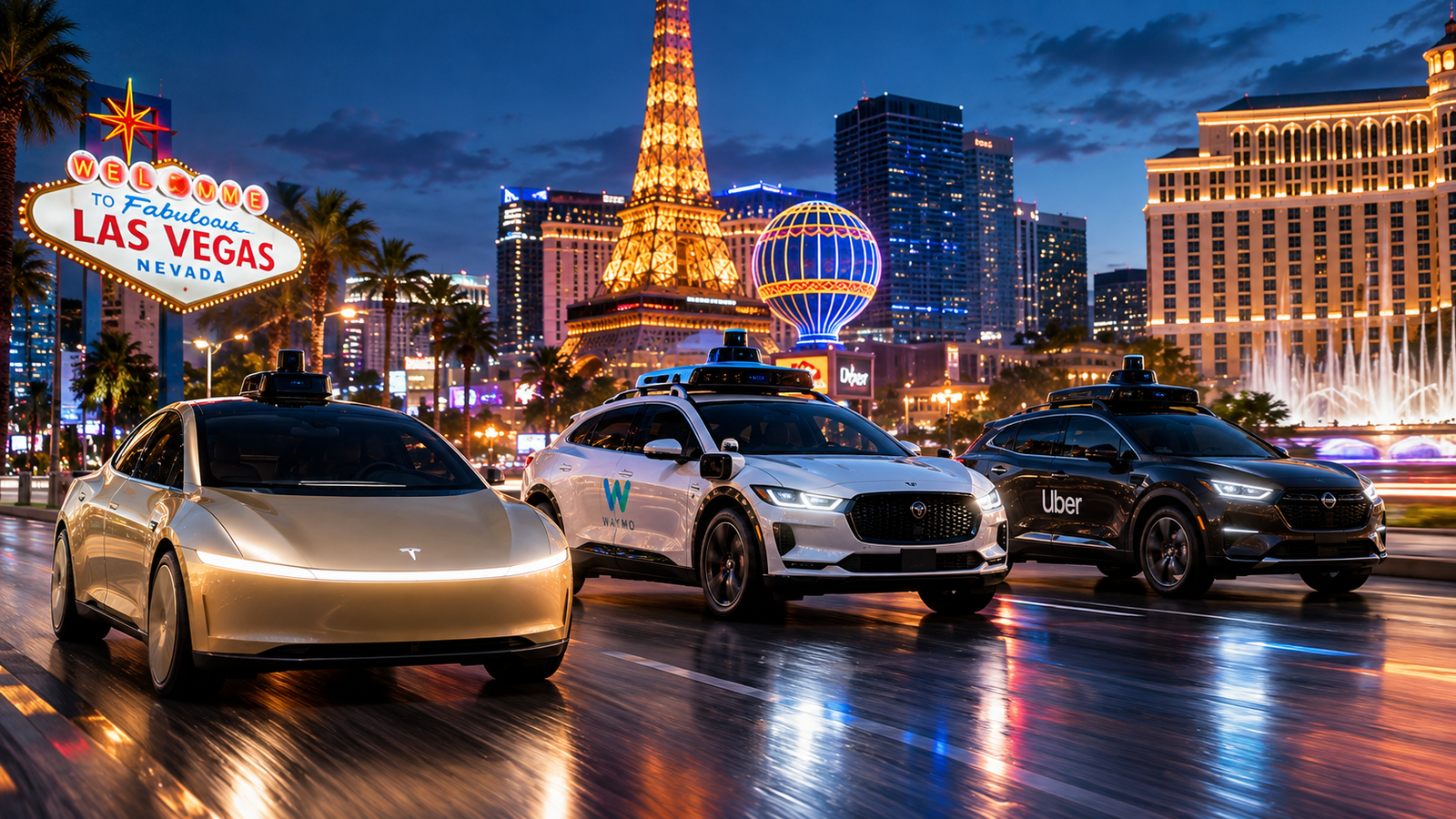
The Robotaxi War Has Started: Tesla vs Waymo vs Uber
What happens when your next taxi doesn't have a driver?
That future no longer sounds like science fiction.
In Nevada, regulators have given the green light for Tesla, Waymo and Uber's autonomous-vehicle operation to deploy up to 7,000 fully autonomous vehicles across Clark County during their first 12 months. Tesla alone can scale to 5,000 vehicles, while Waymo and Uber's autonomous network company each received authorization for up to 1,000.
Las Vegas could become one of the biggest battlegrounds yet.
And the prize isn't just taxi fares.
It's the future of transportation.
Because if a car can pick you up, drive you across the city and drop you off without anyone sitting behind the wheel, what exactly happens to the traditional taxi driver?
That's the uncomfortable question sitting underneath the robotaxi boom.
1. Why Is Las Vegas Suddenly Ground Zero for the Robotaxi War?
Here's where things get interesting.
Nevada's Transportation Authority unanimously approved autonomous vehicle network applications for Tesla Robotaxi, Waymo and Aviari Services, Uber's autonomous network company, on August 20, 2026. The permits cover paid passenger transportation in fully autonomous vehicles within Clark County, subject to specific operational conditions.
And Clark County isn't just another American market.
It's Las Vegas.
Millions of visitors arrive here every year. People constantly need transportation between hotels, casinos, restaurants, airports, shopping areas and entertainment venues.
That makes Las Vegas almost like a giant real-world laboratory for robotaxis.
The approved limits are striking:
Company | Nevada authorization | First 12 months |
|---|---|---|
Tesla Robotaxi | Up to 5,000 vehicles | Clark County |
Waymo | Up to 1,000 vehicles | Clark County |
Uber/Aviari | Up to 1,000 vehicles | Clark County |
Combined | Up to 7,000 | Clark County |
There's an important catch, though.
These numbers are ceilings, not promises that all 7,000 vehicles will suddenly appear on Las Vegas streets. Tesla representatives told regulators they didn't expect to reach the full 5,000 during the first year and would be happy with roughly 2,500 or somewhat more.
Still, the regulatory signal is enormous.
Nevada is effectively saying: We're ready for this technology to scale.
And that changes the game.
2. Tesla Has the Biggest Number—But Does That Mean It Will Win?
At first glance, Tesla looks like the obvious favorite.
Five thousand approved vehicles versus 1,000 each for Waymo and Uber?
That's a huge advantage.
But robotaxi competition isn't a simple numbers game.
Tesla is taking a different approach from Waymo. Its purpose-built Cybercab is designed without a steering wheel or pedals, while Tesla is also operating Robotaxi services with Model Y vehicles. Tesla currently lists Robotaxi service in Austin, Dallas, Houston, Miami, Orlando and Tampa, with Cybercab rides available in limited areas of Austin.
The Cybercab is particularly interesting.
It's essentially a car designed around the idea that the passenger—not the driver—is the customer.
No steering wheel.
No pedals.
A two-person cabin.
A touchscreen.
The traditional driver's seat suddenly becomes irrelevant.
That's a radical change in how we think about a car.
But Tesla has something else on its side: scale.
If the company can successfully make autonomous driving work across a large fleet of vehicles, the economics could become extremely powerful.
More cars mean more rides.
More rides mean more real-world data.
More data can help improve the system.
And better systems can potentially support even more vehicles.
That's the theory.
Whether reality follows the theory is the billion-dollar question.
3. Waymo Has a Problem Tesla Can't Easily Copy
But wait.
If Tesla has the biggest approved fleet, why shouldn't Waymo simply be written off?
Because Waymo has something incredibly valuable:
experience.
On September 1, 2026, Waymo began welcoming public riders in Denver, San Diego and Tampa, bringing its fully autonomous service to 14 cities. The company also says its vehicles have accumulated more than 200 million fully autonomous miles.
That's not a small experiment anymore.
Waymo has spent years building a system around a very specific idea: operate a fully autonomous ride service inside carefully defined areas.
And that matters.
Autonomous driving isn't just about making a car recognize a traffic light.
A robotaxi has to deal with:
Pedestrians stepping into the road
Emergency vehicles
Construction zones
Weird parking situations
Cyclists
Aggressive drivers
Road closures
Unusual intersections
Bad weather
Unexpected human behavior
Humans are messy.
Cities are even messier.
Waymo's advantage is that it has been collecting experience from those messy situations for years.
So while Tesla may have the larger potential fleet in Nevada, Waymo enters the fight with considerable operational experience.
That's a very different kind of advantage.
4. Uber Isn't Trying to Build the Same Robotaxi
Here's the twist most people miss.
Uber doesn't necessarily need to build the best autonomous car.
It already has something the autonomous-vehicle companies desperately need:
the customers.
Uber's strategy is increasingly about becoming the marketplace where autonomous vehicles and human drivers coexist.
The company says autonomous vehicles are part of a future hybrid network rather than an immediate replacement for its conventional driver network.
And Uber is partnering with multiple autonomous companies.
In Las Vegas, riders can already be matched with Motional's all-electric IONIQ 5 robotaxi through Uber. Uber has also announced a partnership with Zoox, with Zoox robotaxis planned for the Uber network in Las Vegas and later Los Angeles.
Think of it this way.
Tesla wants to control the car and autonomous technology.
Waymo wants to control the autonomous driving system and robotaxi service.
Uber wants to control the doorway through which passengers request the ride.
That's three very different strategies.
And that makes this war much more interesting than simply "Tesla versus Waymo."
5. The Real Battle Might Be Over One Thing: Cost
Now we get to the part that could decide everything.
Price.
Imagine two rides.
One costs $18 with a human driver.
The other costs $12 with an autonomous vehicle.
Which one would most passengers choose?
Probably the cheaper one.
That's why robotaxis aren't simply competing on futuristic technology. They're ultimately competing on transportation economics.
A human driver needs to be paid.
An autonomous vehicle doesn't receive a traditional driver's wage.
But robotaxis aren't free to operate.
There are still costs for:
Vehicle purchase
Electricity
Charging
Insurance
Maintenance
Cleaning
Fleet management
Remote assistance
Mapping
Computing
Software development
Depreciation
So the promise isn't simply “no driver = cheap ride.”
The real question is whether the total operating cost of an autonomous fleet can eventually become low enough to beat conventional ride-hailing.
Uber clearly sees the possibility.
Its 2026 materials describe autonomous vehicles and human drivers operating together and say partners have committed approximately 120,000 vehicles to the Uber network over the coming years.
That's a massive number.
And it tells us something.
Uber isn't treating robotaxis like a side experiment anymore.
It's preparing its platform for a transportation system where humans and machines compete—and cooperate—for the same passengers.
6. So… Will AI Actually Replace Taxi Drivers?
This is where the headline gets uncomfortable.
Possibly, but probably not overnight.
Robotaxis will first expand in controlled service areas.
Then companies will gradually add more roads, more neighborhoods and more cities.
Some driving jobs may shrink.
At the same time, entirely different jobs could grow around autonomous fleets.
Someone still needs to maintain the vehicles.
Someone needs to clean them.
Someone needs to manage charging.
Someone needs to monitor fleet operations.
Someone needs to handle unusual situations.
Someone needs to build and maintain the software.
So the future probably isn't as simple as:
Human drivers disappear. Robots take over.
It's more likely to look like a slow reshuffling of transportation jobs.
Uber itself describes its future as a hybrid network where autonomous vehicles operate alongside conventional drivers.
And that's probably the realistic version of the story.
For a while, you may open an app and have two choices:
Human driver — $17
Robotaxi — $12
Which one would you pick?
That's when the robotaxi revolution becomes much more than a technology story.
It becomes a consumer-choice story.
🤖 Tesla vs Waymo vs Uber: Who Has the Best Shot?
If we judge them by different strengths, the picture becomes clearer.
Category | Tesla | Waymo | Uber |
|---|---|---|---|
Fleet scaling potential | ⭐⭐⭐⭐⭐ | ⭐⭐⭐⭐ | ⭐⭐⭐⭐ |
Autonomous-driving experience | ⭐⭐⭐⭐ | ⭐⭐⭐⭐⭐ | ⭐⭐⭐ |
Passenger network | ⭐⭐⭐ | ⭐⭐⭐ | ⭐⭐⭐⭐⭐ |
Purpose-built robotaxi | ⭐⭐⭐⭐⭐ | ⭐⭐⭐⭐⭐ | Partner-dependent |
Existing ride-hailing platform | ⭐⭐ | ⭐⭐⭐ | ⭐⭐⭐⭐⭐ |
Nevada authorization | Up to 5,000 | Up to 1,000 | Up to 1,000 |
Biggest advantage | Scale | AV experience | Customer network |
There isn't one obvious winner.
And that's precisely why this race is fascinating.
Tesla has scale and a radically different vehicle strategy.
Waymo has years of autonomous driving experience.
Uber has millions of people already accustomed to ordering rides from a phone.
The winner could even be a combination of them.
Uber could distribute Waymo rides.
Tesla could build its own network.
Other companies could supply autonomous vehicles behind the scenes.
The transportation industry is being rearranged in real time.
🚦 The Robotaxi Revolution Has Already Started
The biggest mistake would be to think this is still five or ten years away.
It isn't.
Waymo is already providing fully autonomous rides across 14 cities. Tesla is already operating Robotaxi services in multiple U.S. cities, while Uber is putting autonomous rides directly onto its platform through partners.
And Nevada just provided one of the clearest signals yet that regulators are willing to let these services scale.
Up to 7,000 autonomous vehicles.
One county.
Three major players.
One enormous transportation experiment.
Las Vegas could become the place where the public finally gets to see what happens when robotaxis stop being a demonstration and start becoming a genuine transportation network.
The question isn't really whether AI can drive.
The bigger question is:
Will passengers trust it enough to stop asking for a human?
❓ FAQs
1. What is a robotaxi?
A robotaxi is an autonomous vehicle designed to transport passengers without a human driver actively controlling the vehicle.
2. How many robotaxis did Nevada approve?
Nevada's official August 2026 approvals authorize up to 5,000 Tesla vehicles, 1,000 Waymo vehicles and 1,000 Uber/Aviari vehicles during their first 12 months in Clark County.
3. Is Waymo already operating fully autonomous taxis?
Yes. Waymo said in September 2026 that it was providing fully autonomous trips in 14 cities after launching public rides in Denver, San Diego and Tampa.
4. Is Tesla's Cybercab completely driverless?
The Cybercab is designed for full autonomy without a steering wheel or pedals. Tesla currently offers limited Cybercab rides in Austin, while its broader Robotaxi service also uses Model Y vehicles in several cities.
5. Will robotaxis replace human taxi drivers?
They could reduce demand for some driving jobs over time, but the transition is unlikely to happen instantly. Uber itself is pursuing a hybrid model in which autonomous vehicles and human drivers operate on the same platform.
🏁 Conclusion: The Taxi Driver's Biggest Competitor May Not Be Another Driver
For more than a century, getting a taxi meant one thing: another human had to drive you.
That assumption is beginning to disappear.
Tesla, Waymo and Uber are now competing to control what comes next, and Nevada's approval for up to 7,000 autonomous vehicles shows just how quickly the experiment is moving.
But don't expect every taxi to disappear tomorrow.
The real transition will probably be gradual.
First, robotaxis operate in selected zones. Then more streets. More cities. More passengers. Eventually, people may stop thinking of autonomous rides as unusual at all.
And that's when the real disruption begins.
Imagine opening your phone five years from now and choosing between a human driver and an AI driver—with the AI ride costing less.
Would you trust an AI taxi to drive you across a busy city, or would you still choose a human driver?
Leave a Comment
Your comment will appear after moderation.