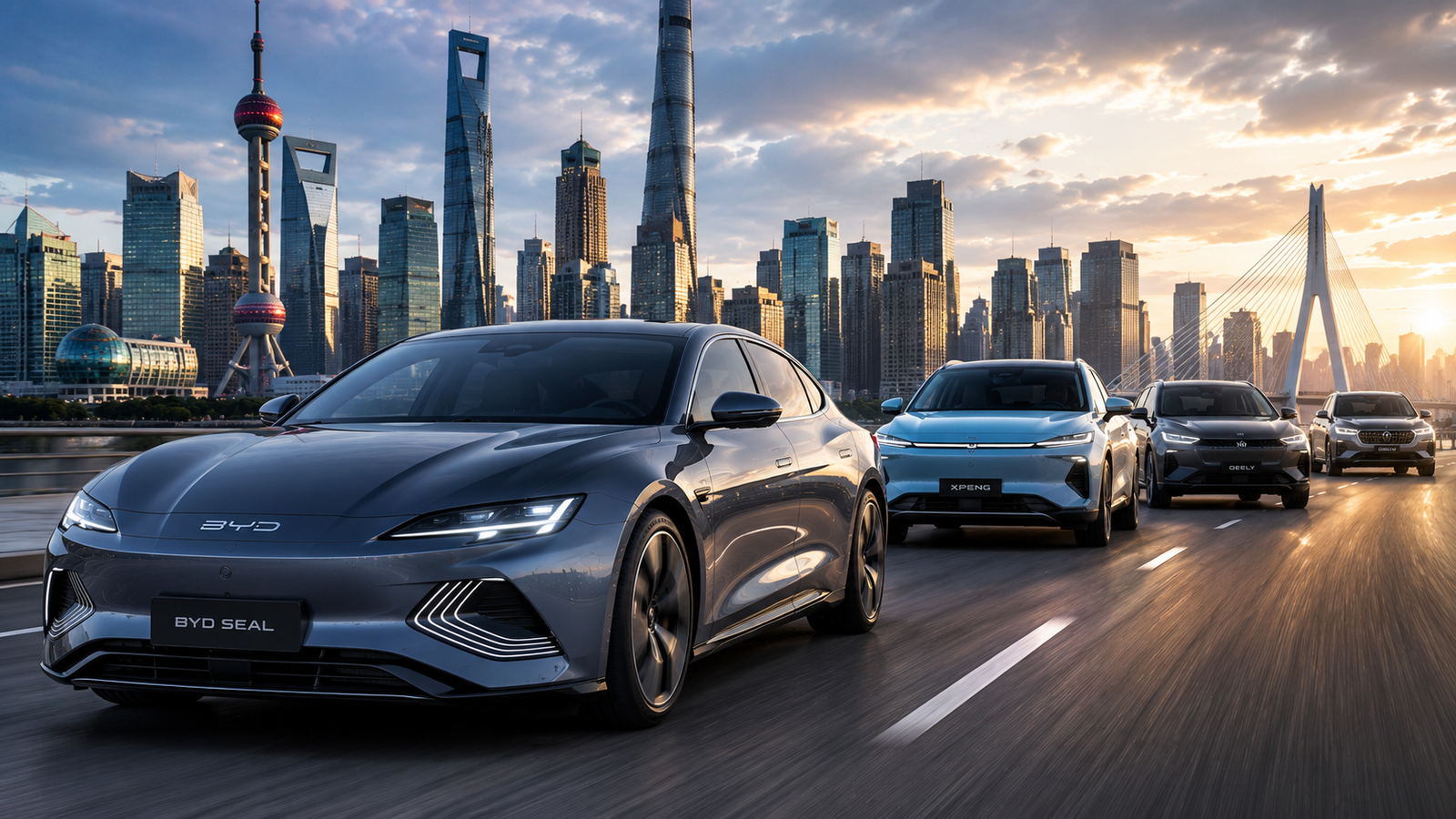
Chinese Cars Are Taking Over Global Markets—Can Traditional Automakers Fight Back?
Could the next generation of the world's biggest car brands come from China?
For decades, the global car industry seemed almost impossible to disrupt. Toyota, Volkswagen, Ford, General Motors, BMW, Mercedes-Benz, Honda and other established names had enormous factories, loyal customers and decades of engineering experience.
Then China's carmakers started leaving home.
What looked like a domestic success story has rapidly become a global challenge. China's electric-car production reached about 16 million vehicles in 2025, while Chinese electric-car exports more than doubled to over 2.5 million. The International Energy Agency says China accounted for nearly 75% of global electric-car production that year.
Now companies such as BYD, Geely, SAIC, Chery, XPeng and Leapmotor are appearing in markets where established brands once seemed untouchable.
But here's the real question:
Are Chinese automakers actually going to replace traditional car companies—or are they simply forcing the old giants to evolve faster than ever?
1. Why Are Chinese Cars Suddenly Everywhere?
The first clue is hidden in the numbers.
China isn't just producing cars for Chinese buyers anymore. Its manufacturers are increasingly treating the rest of the world as their next growth opportunity.
In 2025, China exported more than 2.5 million electric cars, roughly double the previous year's figure. The IEA also found that four out of every five Chinese-made electric cars sold overseas in 2025 came from Chinese manufacturers rather than foreign brands producing vehicles in China.
That is a major change.
For years, international automakers used China primarily as a manufacturing and sales base.
Now Chinese companies are increasingly using China as a launchpad for global brands.
And they have a powerful advantage:
They learned to build EVs at enormous scale while their competitors were still deciding how aggressively to enter the electric market.
China developed a huge domestic EV ecosystem involving batteries, electronics, motors, software, suppliers and manufacturing.
Think of it like building an entire kitchen before opening a restaurant.
Once everything is already there, producing the next meal becomes much faster.
That's one reason Chinese EV manufacturers can move so quickly.
But speed isn't their only weapon.
2. The Secret Weapon Isn't Just Cheap Prices
It's tempting to explain China's rise with one sentence:
“Chinese cars are cheaper.”
That isn't completely wrong—but it's nowhere near the whole story.
Chinese automakers are competing through a combination of price, technology, manufacturing scale and rapid product development.
Take BYD.
The company has expanded dramatically outside China, with overseas sales becoming increasingly important. In August 2026, BYD's global sales rose 17.8% year over year to 440,293 vehicles, while overseas shipments jumped 134.5% to 189,466.
That's not simply a cheap-car strategy.
It's a global expansion strategy.
And buyers are getting more choices.
Modern Chinese EVs increasingly offer:
Large infotainment displays
Advanced driver-assistance systems
Smartphone-style software
Fast charging
Long-range batteries
Premium interiors
Over-the-air updates
Competitive pricing
Some models are also arriving with technology that would once have been associated primarily with expensive luxury cars.
This creates an uncomfortable problem for traditional manufacturers.
If a customer can buy a cheaper vehicle with impressive technology, why automatically pay more for a familiar badge?
That's the question established brands have to answer.
3. Europe Is Already Showing What Happens Next
Here's where the story gets especially interesting.
Europe has traditionally been one of the world's strongest automotive regions.
Volkswagen.
BMW.
Mercedes-Benz.
Renault.
Stellantis.
Audi.
These aren't small companies.
Yet Chinese manufacturers are steadily gaining ground.
Reuters reported in June 2026 that Chinese automakers had reached around 6.4% of the EU market, while their share in the UK had doubled to about 15% during the year. In Israel, Chinese manufacturers held more than 40% of the market.
Those numbers don't mean Chinese companies have conquered Europe.
Far from it.
European manufacturers still have enormous market shares, strong dealer networks and powerful brands.
But the direction matters.
A newcomer doesn't need to become number one overnight.
If it moves from almost irrelevant to a meaningful market share in only a few years, established manufacturers have to pay attention.
And they are.
The European Union has already introduced additional tariffs on Chinese-made EVs, reflecting concerns about competition and the impact of Chinese imports on European manufacturers.
That creates another fascinating question:
If Chinese cars weren't considered a serious threat, why would governments and major automakers be spending so much time responding to them?
4. The Biggest Advantage China Has May Be Speed
But here's the part traditional automakers may find hardest to copy.
Speed.
A conventional automaker can take years to develop a new vehicle.
There are design teams.
Engineering teams.
Suppliers.
Testing.
Regulatory approvals.
Factories.
Marketing.
Dealers.
Then comes production.
Chinese EV companies have developed extremely fast development cycles in an intensely competitive domestic market.
That competition can be brutal.
China's EV market has experienced major price competition, forcing manufacturers to find ways to lower costs while adding more technology.
The result?
Companies have become extremely good at iterating quickly.
A new battery technology appears.
A supplier improves a component.
A software feature becomes popular.
A manufacturer can incorporate the change into future products.
It's similar to the difference between updating a traditional computer every five years and constantly updating a smartphone.
The traditional automotive industry is now learning that a car can increasingly behave like a technology product.
And that's a huge cultural change.
5. Even GM Is Betting on Chinese Capabilities
One of the clearest examples comes from an unlikely partnership.
General Motors and SAIC Motor recently agreed to extend their SAIC-GM joint venture for another 20 years, through 2047.
The partnership began in 1997, meaning the relationship will eventually span half a century. The renewed agreement calls for the companies to coordinate technology development, supply chains and global resources, with a major focus on electric and intelligent vehicles.
And there is another number worth remembering:
30.
SAIC-GM plans to launch at least 30 new-energy vehicle models by 2030.
The strategy isn't simply about selling more cars in China.
The partners are also looking at international markets, including the Middle East, Africa, South America, Mexico and Asia-Pacific.
That's significant because it reveals something bigger.
Traditional Western automakers don't necessarily view China only as a competitor.
They increasingly see Chinese manufacturing, engineering and supply-chain capabilities as resources they can work with.
In other words, the future might not be:
China versus everyone else.
It could become:
Global automakers + Chinese technology + global manufacturing networks.
That's a much more complicated—and interesting—future.
6. But Chinese Automakers Have a Problem Too
Before declaring China the inevitable winner, there's an important reality check.
Going global is much harder than exporting a container of cars.
A successful international automotive brand needs:
Trust.
Service networks.
Parts availability.
Crash-test performance.
Local regulations.
Resale value.
Financing.
Brand recognition.
Imagine buying an unfamiliar car and discovering that the nearest authorized service center is several hundred miles away.
Suddenly, the attractive price doesn't look quite as attractive.
That's why building a global automotive brand can take decades.
Traditional automakers have an enormous advantage here.
Toyota has generations of loyal customers.
BMW has a powerful luxury identity.
Ford has enormous recognition in North America.
Volkswagen has a huge European footprint.
Mercedes-Benz carries a century of brand history.
Chinese companies have to build much of that reputation from scratch.
And there is another obstacle:
Geopolitics.
Governments can influence which vehicles enter their markets through tariffs, trade rules, subsidies, security regulations and local-content requirements.
The United States, Europe and other regions are already taking different approaches toward Chinese automotive imports.
So the global expansion of Chinese cars won't be determined by engineering alone.
Politics will matter too.
7. What Happens to Toyota, Volkswagen, Ford and GM?
Now we reach the most important question.
Are traditional automakers finished?
Absolutely not.
But they can't assume their historical advantages will protect them forever.
The companies that survive this transition will probably be the ones willing to change.
And we're already seeing signs of that.
Honda, for example, is pursuing major cost reductions as it responds to pressure from Chinese EV manufacturers. Reuters reported in September 2026 that Honda is targeting more than $9 billion in cost reductions by 2030, while asking suppliers to cut costs significantly in several areas, including software-related components.
Volkswagen is also under pressure.
The company is attempting another major restructuring in Germany as it tries to become more competitive against faster-moving Chinese manufacturers.
So the response isn't simply “build more EVs.”
It's becoming:
Reduce costs
Improve software
Develop faster
Simplify manufacturing
Strengthen batteries
Improve charging
Update vehicles more frequently
Use partnerships strategically
Understand what younger buyers actually want
The old giants still have enormous resources.
The question is whether they can move quickly enough.
A New Automotive Power Balance?
Factor | Chinese Automakers | Traditional Automakers |
|---|---|---|
EV manufacturing scale | Very strong | Varies by company |
Battery ecosystem | Major advantage | Improving |
Software development speed | Rapid | Historically slower |
Global brand history | Relatively young | Major advantage |
Dealer/service networks | Expanding | Major advantage |
EV price competition | Very aggressive | More cautious |
Global market presence | Growing rapidly | Already extensive |
Manufacturing experience | Extremely strong | Extremely strong |
Customer loyalty | Developing | Major advantage |
Global expansion | Accelerating | Established |
Neither side has won.
That's what makes the next decade so fascinating.
China has speed and scale.
Traditional automakers have experience, brands, global infrastructure and enormous financial resources.
So what happens when those strengths collide?
8. The Next Decade Could Look Nothing Like the Last One
Here's the part most people aren't talking about.
The biggest change may not be that Chinese brands replace Western, Japanese or Korean brands.
The bigger change could be that the entire definition of a successful car company changes.
For decades, success depended heavily on:
Engine technology.
Mechanical reliability.
Factory scale.
Dealer networks.
Brand reputation.
Now add:
Software.
Batteries.
AI.
Data.
Fast charging.
Digital services.
Over-the-air updates.
Autonomous driving.
A company that is brilliant at engines but slow at software may suddenly find itself fighting a completely different battle.
And Chinese manufacturers have been developing inside one of the world's most competitive EV environments.
The IEA says Chinese EV exports are increasingly moving beyond Europe, with strong growth in Southeast Asia, the Middle East and Latin America during 2025.
That matters enormously.
Because global expansion is no longer a distant possibility.
It is already happening.
And as Chinese manufacturers establish factories, dealerships and customer bases overseas, they become harder to treat as temporary newcomers.
So, Who Actually Wins?
The honest answer is:
Nobody knows yet.
Chinese automakers have enormous momentum, but they face tariffs, political resistance, unfamiliarity with some brands and the challenge of building long-term customer trust.
Traditional automakers aren't disappearing either.
They have decades of engineering knowledge, huge production facilities, powerful dealer networks and some of the strongest automotive brands on Earth.
But one thing has already changed.
The old giants can no longer assume they automatically control the future.
The competition has become global.
And increasingly, the most dangerous competitor isn't the company with the biggest factory.
It's the company that can develop a good car, manufacture it cheaply, improve it quickly and sell it somewhere new before everyone else has figured out what happened.
That's exactly what makes China's automotive rise so fascinating.
The question isn't simply whether Chinese cars will conquer the world.
It's whether the traditional giants can change quickly enough to compete in the world China is helping create.
FAQs
1. Why are Chinese cars becoming popular worldwide?
Chinese automakers combine large-scale manufacturing, competitive pricing, EV technology and increasingly sophisticated software. Their overseas exports have grown rapidly, particularly in emerging markets and Europe.
2. Is BYD bigger than traditional automakers?
BYD has become one of the world's most important EV manufacturers, but it has not replaced the largest traditional automakers across the entire global vehicle market. Its international expansion is growing particularly quickly.
3. Why are Chinese EVs often cheaper?
China has a huge automotive supply chain and battery ecosystem, allowing manufacturers to achieve enormous production scale. Fierce domestic competition has also pushed companies to reduce costs.
4. Are Chinese cars available in the US?
Availability depends heavily on the brand, vehicle and current US trade and regulatory policies. The US market has much higher barriers to Chinese-made vehicles than many other regions.
5. Can traditional automakers compete with Chinese car companies?
Yes. Established manufacturers still have major advantages in brand recognition, global distribution, engineering expertise and customer trust. However, they need to improve cost efficiency, software, EV technology and development speed to remain competitive.
Conclusion: The Car War Has Changed
The global automotive industry is entering one of its biggest transformations in generations.
Chinese manufacturers aren't simply exporting cars. They are exporting a new approach to automotive development—one built around EVs, batteries, software, rapid product cycles and aggressive international expansion.
The numbers show why traditional automakers are paying attention: China produced roughly 16 million electric cars in 2025, and Chinese electric-car exports exceeded 2.5 million.
But don't write off the old giants yet.
Toyota, Volkswagen, Ford, GM, BMW, Mercedes-Benz and others still possess enormous advantages that took decades to build.
The real battle will be about who can combine technology, affordability, quality, trust and speed better than everyone else.
And that's why the next decade could completely reshape the list of companies we think of as automotive superpowers.
What do you think—will Chinese automakers eventually dominate the global car market, or will traditional brands find a way to fight back? Drop your prediction in the comments and share this article with another car enthusiast. 🚗🌍
Leave a Comment
Your comment will appear after moderation.