China EV Recall 2026 | EV Safety | Tesla | Automotive Technology
4.3 million vehicles. Nine automakers. One surprisingly simple problem.
China has just launched the largest vehicle recall in its history, and the issue isn't a failing battery, a defective motor, or some mysterious piece of futuristic software.
It is the way some people may struggle to open a car door during an emergency.
That sounds almost too ordinary to make headlines. But when the electrical system of a modern vehicle fails after a serious crash, a hidden or difficult-to-find emergency door release can become a serious safety concern. China's latest recall affects about 4.3 million vehicles from nine automakers, including Tesla, Xiaomi and Leapmotor.
And that's what makes this story so interesting.
The recall isn't really about whether electric cars are "good" or "bad." It's about something much bigger: what happens when car companies become so focused on making vehicles smarter, sleeker and more futuristic that basic human needs become harder to access?
1. How Did a Door Handle Turn Into a 4.3 Million-Car Problem?
Here's where the story gets interesting.
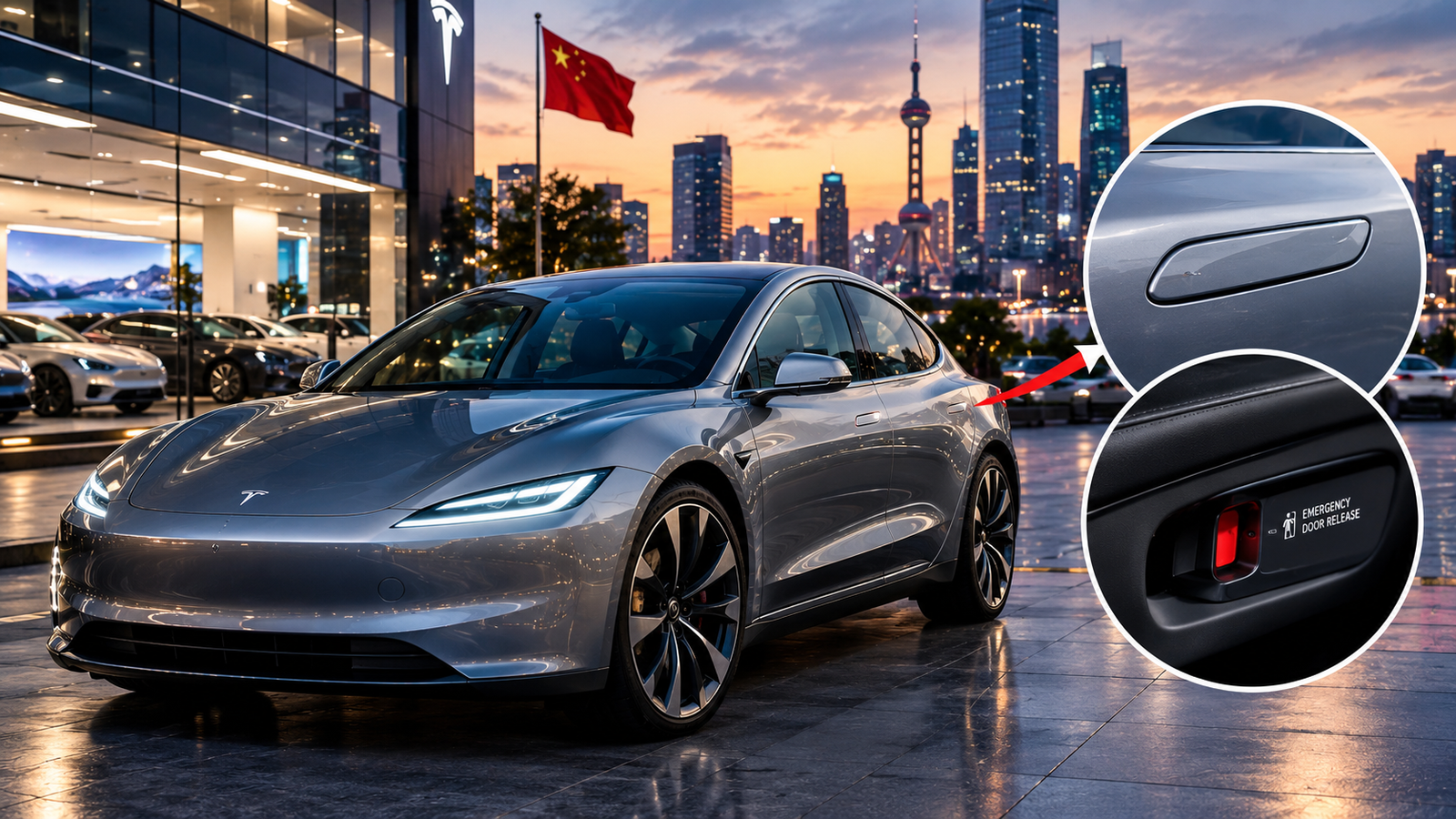
Modern EV designers love clean surfaces. Flush door handles look futuristic, reduce visual clutter and can offer aerodynamic advantages. Tesla helped popularize this design, and other manufacturers followed.
From the outside, it looks brilliant.
The handle disappears into the bodywork. The car looks smoother. The design feels more like a smartphone than a traditional automobile.
But there is a catch.
Inside some affected vehicles, the emergency mechanical release can be difficult to identify because it is visually similar to the surrounding interior trim. China's market regulator said that in an extreme situation—such as a severe collision that causes the vehicle's low-voltage electrical system to fail—occupants may have difficulty finding and operating the release quickly. That could delay escape or make rescue harder.
Think of it like an emergency exit in a building.
It doesn't matter how beautiful the building is if nobody can find the exit when the lights go out.
That is essentially the lesson behind this recall.
The affected designs aren't necessarily impossible to operate. The concern is that they may be too difficult to identify or use at exactly the moment when seconds matter.
And that is a very different problem from an ordinary convenience issue.
2. Why Is Tesla at the Center of the Story?
Tesla is receiving most of the attention because it represents the largest individual portion of the recall.
China's official recall notices cover roughly 2.98 million Tesla vehicles, including China-made and imported Model 3, Model Y, Model S and Model X vehicles.
That is an enormous number.
For comparison, the Tesla portion alone represents roughly 69% of the 4.3 million vehicles included in the nine-automaker door-release recall.
Automaker / Brand | Approx. Vehicles Affected | Main Remedy |
|---|---|---|
Tesla | 2.98 million | Warning labels + OTA window-control update |
Xiaomi | 390,435 | Labels + OTA software changes |
Leapmotor | 371,200 | Labels + OTA window strategy |
XPeng | 264,842 | Emergency-release warning labels |
Zeekr | 92,658 | Recall measures for affected models |
The figures above come from Chinese regulatory filings and reporting on the recall campaign.
Tesla's remedy is particularly interesting because part of the fix can happen without taking the vehicle into a workshop.
The company plans to add warning labels around the emergency mechanical releases and use an over-the-air software update to introduce a post-crash window-lowering strategy.
That's a perfect example of the strange world modern cars now live in.
A traditional mechanical problem might require a mechanic.
A modern software-connected vehicle can sometimes be changed remotely.
But isn't it ironic?
The same technology that makes a car easier to update can also create new layers of complexity.
3. The Recall Isn't Really Saying EVs Are Unsafe
This is probably the most important point for anyone reading the headline.
This is not a battery recall.
The recall does not mean electric motors are suddenly dangerous. It does not mean EV batteries are failing across the industry. And it certainly doesn't prove that gasoline cars are automatically safer.
The specific concern is emergency door operation.
That's an important distinction because EV discussions often become unnecessarily polarized.
One side says electric vehicles are the future.
Another says EVs are full of problems.
Reality is much less dramatic.
Electric cars have their own engineering challenges, just as gasoline cars do.
The difference is that EVs are increasingly packed with electronic systems, software, cameras, screens, sensors and electrically controlled components.
That creates opportunities for incredible features.
But it also creates new failure scenarios.
Imagine your car as a smartphone on wheels.
A smartphone can do hundreds of things a basic phone never could.
But when the battery dies, a complicated smartphone doesn't suddenly become a better flashlight than a simple mechanical one.
Cars have the same principle.
Sometimes the simplest physical solution remains the most dependable one.
4. Why China's Response Could Change Car Design Worldwide
But here's where this recall becomes much bigger than Tesla.
China has announced that concealed door handles will be banned on new vehicles from 2027, making it the first country to phase out the design.
That could have consequences far beyond China.
Why?
Because Chinese automakers have become some of the world's most aggressive users of new automotive technology and design.
If Chinese safety rules change, manufacturers selling there have to adapt.
And companies rarely want to create completely different designs for every market.
So a rule introduced in one major automotive market can influence global vehicle design.
It's similar to what happened with other safety regulations over the decades.
Once manufacturers develop a safer solution that works across markets, the change can spread.
The bigger message is clear:
Innovation is not just about adding technology. It's also about knowing when technology has gone too far.
A door handle might look like a tiny piece of the car.
Multiply that philosophy across dozens of systems and you begin to understand the challenge facing modern automakers.
5. The Hidden Problem With “Smarter” Cars
Here's the uncomfortable question:
Are modern cars becoming too clever?
Walk into a new vehicle showroom today and you'll find enormous screens, voice assistants, facial cameras, smartphone connectivity, automatic parking, advanced driver assistance and software that can receive updates remotely.
It's impressive.
But ask an ordinary driver to find an emergency control they've never used before, and suddenly all that sophistication means very little.
This is where good engineering and good design have to meet.
A technology can be technically brilliant but still poorly designed for humans.
Think about an elevator.
You don't need to understand its computer system to press the emergency button.
You don't need a manual.
You don't need an internet connection.
The button is obvious.
Cars should follow the same principle for critical safety controls.
The most important controls should be the easiest ones to understand.
6. What This Means for People Buying EVs
So should buyers be worried?
Not necessarily.
A recall is actually one of the tools that makes modern vehicles safer.
When a manufacturer discovers a potential safety problem and regulators require corrective action, owners can receive a fix without paying for the repair themselves.
For the affected Tesla vehicles in China, the official remedy includes warning labels and an OTA software update designed to lower windows after certain serious collisions.
The more useful lesson for buyers is not:
“Don't buy an EV.”
It is:
“Understand the technology in the EV you buy.”
Before purchasing any modern vehicle, buyers should know:
How do the doors work if the electrical system loses power?
Where are the emergency mechanical releases?
Can passengers easily identify them?
What happens after a serious crash?
Which features depend on software?
Can important safety updates be installed remotely?
Has the vehicle been subject to any recalls?
These aren't questions only EV buyers should ask.
They make sense for almost every modern vehicle.
7. The Bigger Warning: Automotive Design Is Moving Faster Than Ever
Perhaps the most fascinating part of this story isn't the number 4.3 million.
It's the speed at which automotive design is changing.
Car companies are competing to make vehicles lighter, smoother, smarter and more technologically advanced.
At the same time, China's auto market has become intensely competitive, with manufacturers racing to introduce new technologies and models quickly. Reuters reported that Beijing has been increasing oversight as automakers compete aggressively in the world's largest vehicle market.
That creates a difficult balancing act.
Move too slowly and a company risks falling behind.
Move too quickly and an innovative feature may not receive enough real-world scrutiny.
The door-handle recall is a reminder that automotive innovation doesn't happen in a vacuum.
Every futuristic feature eventually has to meet an ordinary human being.
And that human being might be sitting in a crashed vehicle, in the dark, trying to figure out how to get out.
That's the moment that matters.
FAQs
1. What caused China's 4.3 million-car recall?
The recall concerns emergency mechanical door releases that may be difficult to identify or operate, particularly after severe crashes that cause a vehicle's low-voltage electrical system to fail.
2. How many Tesla vehicles are affected?
Approximately 2.98 million Tesla Model 3, Model Y, Model S and Model X vehicles are included in the relevant China recall.
3. Does this mean electric cars are unsafe?
No. The recall concerns a specific emergency door-release design issue. It is not a general finding that EV batteries or electric motors are unsafe.
4. Why are hidden door handles being criticized?
They can look clean and futuristic, but emergency mechanical releases may be harder to locate and operate, especially during stressful situations or after electrical-system failures.
5. Will hidden door handles disappear completely?
China has announced plans to ban concealed door handles on new vehicles from 2027. Other markets and manufacturers may respond differently.
Conclusion: When Innovation Has to Know Its Limits
The biggest lesson from China's historic 4.3 million-vehicle recall isn't that electric cars have failed.
It's almost the opposite.
The automotive industry is moving so quickly that regulators, engineers and manufacturers are being forced to reconsider what “better” actually means.
A smoother door handle may look better.
A software-controlled system may feel smarter.
A screen may offer more features.
But when something goes wrong, the best technology is often the technology that a frightened person can understand immediately.
That's why this recall matters far beyond China or Tesla. It raises a question every automaker should be asking:
Are we designing cars for technology—or are we designing technology around people?
The future of cars will undoubtedly be smarter. The real challenge is making sure they remain simple when simplicity matters most.
What do you think—are modern cars becoming too complicated, or is this simply the price of automotive innovation? Share your thoughts in the comments.
Leave a Comment
Your comment will appear after moderation.