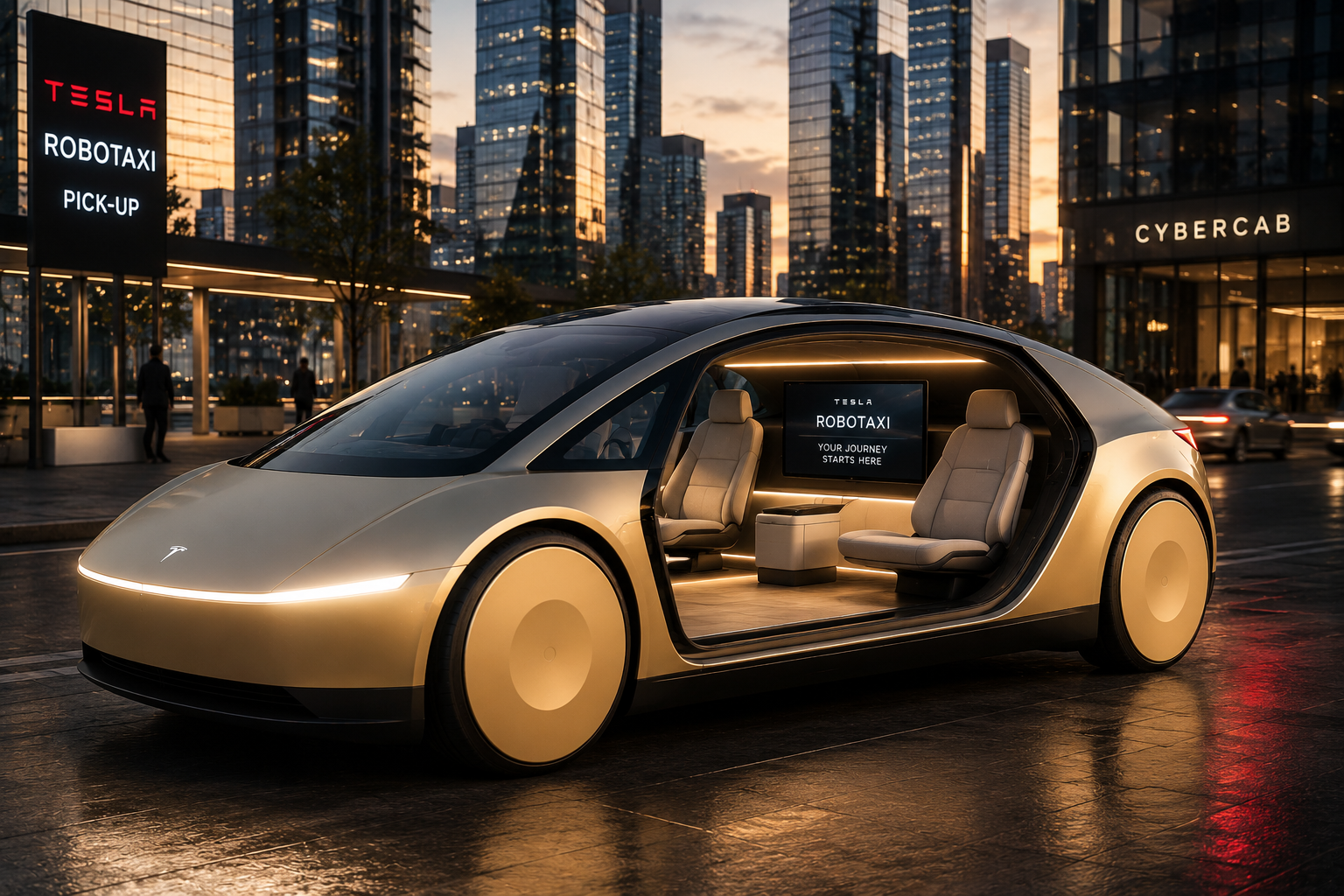
There is something strangely unsettling about looking inside a car and not seeing a steering wheel.
For more than a century, the steering wheel has been one of the most familiar parts of the automobile. You sit behind it, turn it, and the car responds.
It represents control.
But Tesla's Cybercab was designed around a completely different idea.
What if the person inside the car doesn't need to control it at all?
Tesla's two-seat Cybercab is a purpose-built autonomous vehicle with no steering wheel and no pedals. And now, that unusual idea is moving closer to real-world passenger service.
According to a Reuters report published August 17, Tesla was preparing to begin a Cybercab rollout in Austin, Texas, starting with employee rides on public roads before potentially adding the vehicles to its Robotaxi service. Tesla had already begun testing production versions on public roads in June.
That makes this more than another futuristic concept car.
It raises a much bigger question:
If cars can drive themselves, why should they still be designed around drivers?
The Car That Doesn't Need You to Drive
The Cybercab isn't simply a normal Tesla with a more advanced version of driver assistance.
It's intended to be something fundamentally different.
There is no traditional steering wheel.
There are no conventional pedals.
Instead, the entire vehicle is designed around autonomous operation and passenger transportation.
That sounds like a small change.
It isn't.
Think about how much of a normal car exists because a human has to drive it.
The steering wheel.
Pedals.
Driver-focused instrument cluster.
Driver's seat position.
Controls positioned around the driver's reach.
Even the shape of the dashboard is influenced by the person sitting behind the wheel.
Remove the driver, and suddenly designers have much more freedom.
The question becomes:
What should a car look like when nobody needs to operate it?
Why Tesla Is Betting So Much on the Cybercab
Tesla's robotaxi ambitions aren't new.
The company has been working toward autonomous ride-hailing for years, and it has already been operating Robotaxi services using modified Model Y vehicles in selected locations.
Tesla's own investor materials have described Cybercab as a vehicle expected to eventually replace the existing Model Y fleet and become the largest-volume vehicle in its Robotaxi fleet.
That's important.
Tesla isn't treating the Cybercab like an experimental side project.
The company's long-term vision is that purpose-built autonomous vehicles could become a major part of its transportation business.
And that's where the economics become interesting.
A privately owned car spends most of its life parked.
A robotaxi could theoretically spend much more of its time carrying passengers.
If autonomous vehicles become reliable enough, one vehicle could potentially serve many different customers throughout the day.
The automobile stops being something you primarily own.
It becomes something you summon.
Austin Could Become the Testing Ground for the Future
Austin is particularly important in this story.
Tesla has already been operating Robotaxi services there, and the company has been testing Cybercab vehicles in the area.
In June, Tesla began testing production Cybercabs without steering wheels or pedals in Austin, initially with a safety monitor present during testing.
Then came the next step.
Reuters reported that Tesla was preparing an August rollout, beginning with employee rides on public roads and potentially moving into Robotaxi service shortly afterward.
The exact timing and scope can still change.
That's important because an announced or reported rollout isn't the same thing as a nationwide driverless revolution.
The Cybercab still has to prove itself in the real world.
And that's where things get difficult.
Driving Is Easy—Until Something Weird Happens
Imagine you're driving down a normal road.
Everything looks predictable.
Then suddenly:
A construction worker moves a barrier.
A delivery truck blocks the lane.
A cyclist appears from behind a parked vehicle.
A traffic officer starts directing cars manually.
A road that normally has two lanes suddenly becomes one.
Humans are surprisingly good at dealing with situations like these.
We don't calculate every possibility mathematically.
We use experience.
We make judgments.
We improvise.
An autonomous vehicle has to turn that complicated human ability into software.
That's one of the hardest problems in self-driving technology.
It's easy to demonstrate a car driving perfectly when everything goes according to plan.
The real test is what happens when nothing goes according to plan.
What Does a Car See?
A vehicle like the Cybercab needs to understand the world around it continuously.
That means detecting vehicles, pedestrians, road markings, traffic signals, obstacles and countless other details.
The computer has to determine:
What is happening?
Then:
What is likely to happen next?
Then:
What should the car do about it?
And it has to repeat that process again and again while the vehicle is moving.
It's almost like giving the car a digital nervous system.
The sensors act like its eyes and ears.
The computers process the information.
The software makes decisions.
The vehicle's control systems execute those decisions.
And the passenger simply sits there.
That final part is what makes the Cybercab so fascinating.
The Driver's Seat Could Become a Passenger Seat
Here's where the Cybercab could change vehicle design more dramatically than people realize.
If there is no driver, why should one person sit facing forward with everything arranged around them?
Why not redesign the cabin completely?
Future autonomous vehicles could potentially have more flexible seating arrangements.
The interior could become a small lounge.
A workspace.
A place to relax.
Or simply somewhere to sit while the car handles the journey.
Instead of asking:
“How comfortable is the driver's seat?”
Manufacturers might eventually ask:
“How useful is the entire cabin?”
That is a completely different philosophy.
But Would People Actually Trust It?
This may be the biggest challenge.
Technology can be incredibly impressive and people can still be nervous about it.
Imagine entering a car for the first time and seeing an empty driver's position.
Your brain immediately asks:
Who's controlling this thing?
The answer is:
A computer.
For some passengers, that will sound exciting.
For others, terrifying.
And trust won't come from advertisements.
It will come from experience.
People will need to see these vehicles operating safely again and again.
They will need to experience journeys themselves.
They will need to understand what happens when the vehicle encounters something unusual.
Only then will driverless transportation begin feeling normal.
And Tesla Isn't Alone
One mistake would be to think Tesla has the entire robotaxi industry to itself.
It doesn't.
Waymo has already built a large autonomous ride-hailing operation, and other companies are developing their own purpose-built vehicles.
Amazon's Zoox, for example, has also created a robotaxi without a conventional steering wheel and pedals. Recent reports say Zoox has begun fare-based driverless service in San Francisco and Las Vegas.
That makes the Cybercab part of a much larger shift.
The competition isn't simply:
Tesla vs another car company.
It's becoming:
Human-driven transportation vs autonomous transportation.
And that could be much bigger.
The Steering Wheel Might Not Disappear From Every Car
Here's something important.
Even if Cybercab succeeds, it doesn't mean steering wheels will suddenly disappear from every vehicle.
There will always be situations where people want to drive.
Sports cars are an obvious example.
Driving enthusiasts don't necessarily want transportation to be automated.
They enjoy the process itself.
For them, driving isn't just a way to reach a destination.
Driving is the destination.
A weekend road trip wouldn't feel the same if you simply sat in the back while a computer handled everything.
So the future may not be a simple choice between human driving and autonomous driving.
Instead, we could end up with both.
Imagine Having Two Different Kinds of Cars
Think about how strange—but useful—the future could become.
Monday morning.
You're late.
You get into an autonomous vehicle and tell it where you're going.
No stress.
No traffic decisions.
No parking search.
You can simply relax.
Then Saturday arrives.
The weather is perfect.
You take out your favorite performance car.
You grab the steering wheel.
And you drive.
The first vehicle is transportation.
The second is entertainment.
Perhaps that is the future.
Autonomous driving for convenience. Human driving for pleasure.
What Happens to Millions of Drivers?
There is also a much more serious side to this transition.
Driving isn't just something ordinary people do.
Millions of people make a living from driving.
Taxi drivers.
Ride-hailing drivers.
Delivery drivers.
Truck drivers.
Bus operators.
Driving instructors.
If autonomous vehicles eventually become widespread, some of these jobs could change significantly.
But the transition is unlikely to happen overnight.
Regulations, public acceptance, technology, insurance and infrastructure will all influence how quickly autonomous transportation expands.
And even highly capable autonomous vehicles may remain restricted to particular areas and conditions for years.
The Biggest Challenge Isn't Building the Car
It might actually be building public confidence.
A human driver is imperfect, but society understands human mistakes.
When a person makes a mistake, we know what happened.
When a computer makes a mistake, people immediately ask a much bigger question:
“Can we trust this technology at all?”
That's why every incident involving autonomous vehicles attracts enormous attention.
The technology doesn't just have to work.
It has to work consistently enough that ordinary people stop thinking about it.
That's the real milestone.
Not the first driverless journey.
The thousandth.
The millionth.
The moment when someone gets into an autonomous car and doesn't even think about the fact that nobody is driving.
So, Are Steering Wheels Really Becoming Obsolete?
Maybe—but probably not everywhere.
The Cybercab is an important experiment because it asks a question that traditional cars never had to answer:
What does an automobile become when the driver disappears?
Tesla's reported Austin rollout could provide one of the clearest real-world tests yet of that idea. Reuters reported that Tesla planned to begin with employee rides on public roads before incorporating Cybercabs into its Austin Robotaxi service, although the reported timetable could still change.
If the vehicle performs well, it could encourage other manufacturers to design cars specifically for autonomous transportation.
If it struggles, the industry will learn something equally valuable.
Either way, the experiment matters.
Because once you remove the steering wheel, you're not simply changing one part of the car.
You're questioning the entire philosophy of what a car is supposed to be.
The Strange Future Waiting Outside Your Door
For more than 100 years, getting into a car meant becoming the driver.
That assumption may finally be changing.
One day, you might open your phone, request a vehicle and watch it arrive with nobody sitting behind the wheel.
You won't ask:
“Who's driving?”
You'll simply get inside.
The car will know where you're going.
It will choose the route.
It will deal with traffic.
And eventually, you may not even remember how strange that once seemed.
But there's one question that will remain.
When cars no longer need drivers…
Will people still want to drive?
That's the fascinating part.
Because the future might not kill driving.
It might finally turn driving into something you do because you want to—not because you have to.
And perhaps that's the real revolution hiding behind the missing steering wheel. 🚘🤖
Leave a Comment
Your comment will appear after moderation.