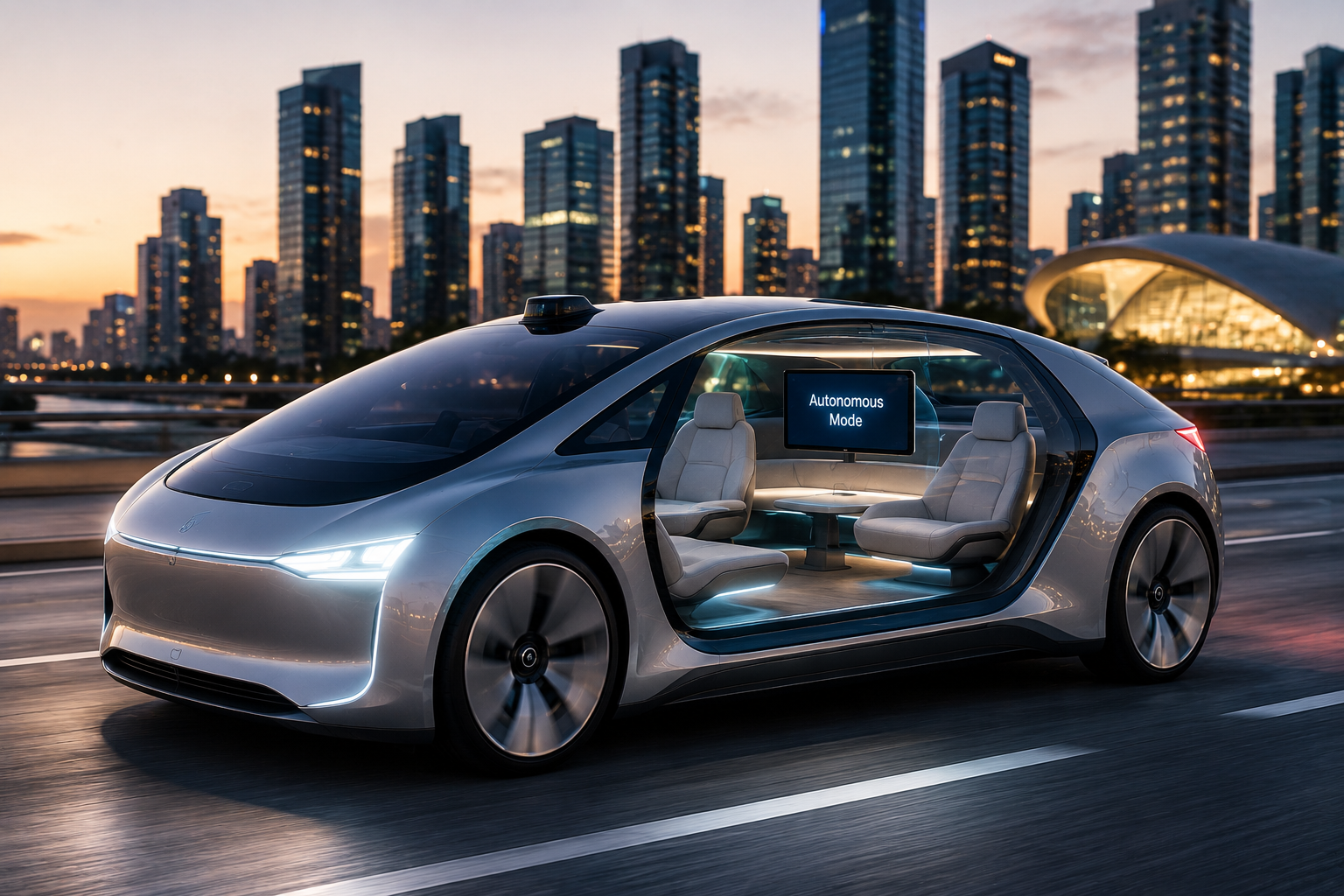
There is a strange moment coming for the automobile.
For more than a century, the basic idea of a car has remained almost unchanged: a human gets inside, takes control, and drives.
You sit behind the steering wheel.
You choose where to go.
You accelerate, brake, turn and park.
But imagine ordering a car from your phone, opening the door, sitting in the back seat—and realizing there is nobody in the driver's seat.
No hands on the steering wheel.
No driver checking the mirrors.
No one asking for directions.
The car simply closes its doors and drives away.
It sounds like science fiction.
Except it isn't entirely science fiction anymore.
Commercial Level 4 autonomous ride-hailing services are already operating in multiple cities. Waymo, for example, says its fully autonomous service had reached more than 10 commercial metro areas by 2026, while other autonomous-driving companies are expanding their fleets and geographic coverage.
The important word here is Level 4.
Because Level 4 doesn't mean a car can drive absolutely anywhere.
It means the vehicle can handle the entire driving task within a defined operating area and conditions, without requiring a human driver to take over.
Level 5 is the much bigger dream: a vehicle capable of driving anywhere a human could drive, under all conditions.
According to the U.S. National Highway Traffic Safety Administration, Level 4 and Level 5 automated driving systems aren't currently available for consumers to simply buy and use as ordinary personal vehicles.
So we're closer than many people realize—but we're not quite at the end of the road.
And that raises a fascinating question:
What happens to the car when the driver is no longer necessary?
The Steering Wheel May Become Optional
For generations, the steering wheel has been one of the most recognizable objects in transportation.
It represents control.
You turn it left.
The car turns left.
You turn it right.
The car follows.
But an autonomous vehicle doesn't necessarily need a human to perform those actions.
Its computer can calculate a path and send commands directly to the steering, braking and acceleration systems.
That's why the long-term future of autonomous vehicles could look radically different from today's cars.
Instead of designing the interior around the driver, manufacturers could design it around passengers.
Seats could face each other.
The dashboard could become smaller.
The windshield could become more like a giant display.
Passengers could work, watch something, read, relax or simply look outside.
The car stops being a machine you operate.
It becomes a space you occupy.
And that is a much bigger change than simply adding better cruise control.
But First, We Need to Understand the Levels
One reason autonomous-driving discussions become confusing is that the phrase “self-driving” gets used for very different technologies.
A car with lane-keeping assistance is not the same thing as a robotaxi.
At Level 2, systems can assist with steering and acceleration/braking, but the human driver remains responsible for monitoring the road.
At Level 3, the vehicle can handle the driving task under certain conditions, but the driver must still be available to take over when requested.
At Level 4, the system can handle driving without a takeover-ready human—but only within its defined operating conditions.
At Level 5, the vehicle would be capable of full automation under essentially all driving conditions.
That distinction matters enormously.
Because a car that can drive itself on a carefully mapped urban route is solving a very different problem from a car expected to drive from a remote village to a mountain road during heavy snow.
The Robotaxi Is Probably the Real Beginning
Here's something interesting.
The first truly driverless cars may not be the cars sitting in your driveway.
They may be taxis.
Why?
Because a robotaxi operates within a defined service area.
The company knows where the vehicle is allowed to operate.
It can carefully map roads.
It can monitor the fleet.
It can update software across thousands of vehicles.
And if a particular road or situation proves too difficult, the operating area can be restricted.
That makes Level 4 much more practical.
Waymo, for example, has been expanding its autonomous ride-hailing network across U.S. cities. In February 2026, the company announced public autonomous service in Dallas, Houston, San Antonio and Orlando, bringing its commercial metro-area count to 10 at that point.
By June, Waymo said its network had expanded to 11 cities and more than 1,400 square miles of coverage, with further expansion planned.
Meanwhile, Chinese autonomous-driving companies are also expanding internationally. Reuters reported in August 2026 that WeRide was operating across more than 60 cities in 13 countries, with a fleet of thousands of Level 4 vehicles, while Pony.ai announced plans to deploy more than 2,000 robotaxis in Europe through its Uber partnership.
So the race isn't theoretical anymore.
It's becoming a transportation business.
Why Can a Car Drive Without a Human?
The secret is not one magical computer.
It's a combination of technologies.
A modern autonomous vehicle can use cameras to understand visual information.
Radar can help detect objects and measure their movement.
Lidar can create detailed information about the surrounding environment.
GPS and mapping systems help determine where the vehicle is.
Onboard computers combine all of that information and continuously calculate what the vehicle should do next.
Imagine you're approaching an intersection.
The car may need to understand:
Where the lane markings are
Whether the traffic light is green
Whether another vehicle is turning
Whether a pedestrian is approaching
Where nearby vehicles are moving
Whether an object has suddenly entered the road
What route the navigation system requires
And it has to make those decisions continuously.
Humans do something similar—but our brains perform the process naturally.
An autonomous vehicle has to turn that perception and decision-making process into software.
That's the difficult part.
The Hardest Problem Isn't the Highway
Highways can actually be relatively predictable.
Cars generally travel in the same direction.
Lane markings are usually visible.
Pedestrians are rare.
Traffic follows clearer patterns.
Now put the autonomous vehicle into a crowded city.
A delivery driver stops unexpectedly.
A pedestrian steps toward the road.
A cyclist moves between lanes.
A traffic officer gives instructions that contradict the traffic lights.
A construction zone changes the normal road layout.
Someone parks illegally.
Suddenly, the neat mathematical problem becomes messy.
This is one reason autonomous-driving companies don't simply announce that their cars can drive everywhere.
The real challenge is handling the unexpected.
Humans are surprisingly good at improvising.
Teaching a computer to do the same thing safely is much harder.
What Happens When the Driver Disappears?
This is where things become really interesting.
If there is no driver, the interior no longer needs to revolve around driving.
Imagine sitting in a vehicle where the front seats aren't particularly important.
You might have two comfortable seats facing backward.
Or perhaps four passengers sitting around a small table.
The vehicle could become a miniature office.
Or a lounge.
Or simply a quiet place to relax during a journey.
The car might even become an extension of your home.
You finish school or work.
You get inside.
You don't drive.
You simply tell the vehicle where you want to go.
The journey becomes your own time.
That could completely change our relationship with distance.
A 45-minute commute wouldn't necessarily mean 45 minutes of concentration.
It could mean 45 minutes of reading, studying, relaxing or talking with friends.
But There Is a Huge Catch
If autonomous cars become widespread, millions of people may no longer need to drive for everyday transportation.
That sounds fantastic.
But it also creates difficult questions.
What happens to professional drivers?
Taxi drivers.
Ride-hailing drivers.
Truck drivers.
Delivery workers.
Driving instructors.
Entire industries are connected to the assumption that a human needs to operate the vehicle.
The transition won't happen overnight.
But the economic impact could become significant if autonomous fleets become cheaper and more widely available.
Some experts expect human drivers and autonomous vehicles to coexist for a long time.
And that's probably more realistic than imagining every steering wheel disappearing at once.
Safety Could Be the Biggest Argument for Autonomous Cars
The strongest argument for automation isn't convenience.
It's safety.
Human beings make mistakes.
We become tired.
We get distracted.
We misunderstand situations.
We react too slowly.
We sometimes make poor decisions.
A computer doesn't become sleepy after driving for eight hours.
It doesn't get angry in traffic.
It doesn't receive a text message and look down at its phone.
That doesn't mean autonomous systems are automatically perfect.
They can make mistakes too.
And when a machine makes a mistake, the consequences can be serious.
That's why regulators and manufacturers are placing enormous emphasis on testing, validation and crash reporting.
NHTSA currently monitors automated-driving and driver-assistance systems and requires reporting of certain crashes involving relevant automated systems.
The goal isn't simply to make a car that can drive.
It's to make a system that can drive safely enough to earn public trust.
What About Level 5?
This is where we should slow down.
Level 5 is the dream everyone imagines.
A car that can drive anywhere.
Any road.
Any weather.
No driver.
No restrictions.
No special operating area.
But that's enormously difficult.
A human driver can encounter almost anything and improvise.
A road may suddenly disappear beneath snow.
A construction crew may completely change an intersection.
A police officer may wave traffic through a closed road.
A flooded street may force an unexpected detour.
A human can reason about the situation.
An autonomous system must be designed and validated to handle these possibilities.
That's why Level 5 remains much further away than commercial Level 4 robotaxis.
NHTSA describes Level 5 as full automation under all conditions and notes that such systems are not currently available to consumers.
So don't expect to buy a Level 5 car next year.
The future will probably arrive in pieces.
The Strange Future of Car Ownership
There's another possibility that could completely change the automotive market.
Maybe people won't own autonomous cars in the same way they own cars today.
Why buy a vehicle that sits outside your house for 23 hours a day?
If autonomous taxis become cheap and reliable, you could simply summon one whenever you need it.
Need a ride to school?
Call one.
Going shopping?
Call another.
Going somewhere with six people?
Request a larger vehicle.
Need a luxury interior for an important trip?
Choose that option.
The idea starts to look less like traditional car ownership and more like an on-demand transportation network.
That could reduce the number of vehicles needed in some cities.
But it could also create new problems, such as increased empty vehicle travel if fleets aren't managed efficiently.
The future isn't automatically better.
It depends on how we design it.
And Then Comes the Emotional Question
Here's the part technology can't answer.
Do people actually want to stop driving?
For millions of people, driving isn't just transportation.
It's freedom.
It's independence.
It's a hobby.
It's the feeling of accelerating onto an empty road.
It's choosing your own route.
It's listening to music while driving at night.
It's the connection between your hands, the steering wheel and the road.
An autonomous car could be safer and more convenient.
But it might also remove something people genuinely enjoy.
That's why the future probably won't eliminate human driving completely.
There will likely always be people who want to drive.
The difference is that driving may become a choice rather than a necessity.
The Car of the Future May Give You a Choice
Imagine owning a car with two personalities.
On Monday morning, you're tired.
You sit down.
You say your destination.
The vehicle drives.
You relax.
On Saturday morning, the road is empty and the weather is perfect.
You switch to manual driving.
The steering wheel becomes active.
The car becomes yours again.
That might be the most interesting future of all.
Not a world where humans are forbidden from driving.
A world where you decide when you want to drive.
Final Thoughts: Are We Really Close?
Yes—but perhaps not in the way science-fiction movies suggest.
Driverless transportation is already moving from laboratories into real streets.
Level 4 robotaxis are operating commercially in defined areas, and companies are expanding into new cities and countries.
But that doesn't mean your next personal car will automatically have no steering wheel.
The transition will probably happen gradually.
First, more advanced driver assistance.
Then limited autonomous driving.
Then larger robotaxi networks.
Then vehicles designed specifically around passengers.
And eventually, perhaps, a world where owning a car with a steering wheel becomes a personal preference rather than a necessity.
The fascinating thing is that the biggest change won't be what happens under the hood.
It will happen inside our heads.
For more than 100 years, we've asked:
“How good is this car at driving?”
One day, we may start asking a completely different question:
“Do I want to drive today—or do I want the car to take me?”
And when that question becomes normal, the automobile will have entered a completely different era.
Leave a Comment
Your comment will appear after moderation.