There was a time when winning the car industry meant having the best engine.
Then it became about horsepower.
Then fuel economy.
Now, something much stranger is happening.
The most important part of a new car may not be under the hood at all.
It might be the software.
A car can now receive updates while sitting in your driveway, learn from cameras and sensors, connect to the internet, assist with driving, and gain new functions without changing a single mechanical component.
And this is where the automotive industry's biggest battle is unfolding.
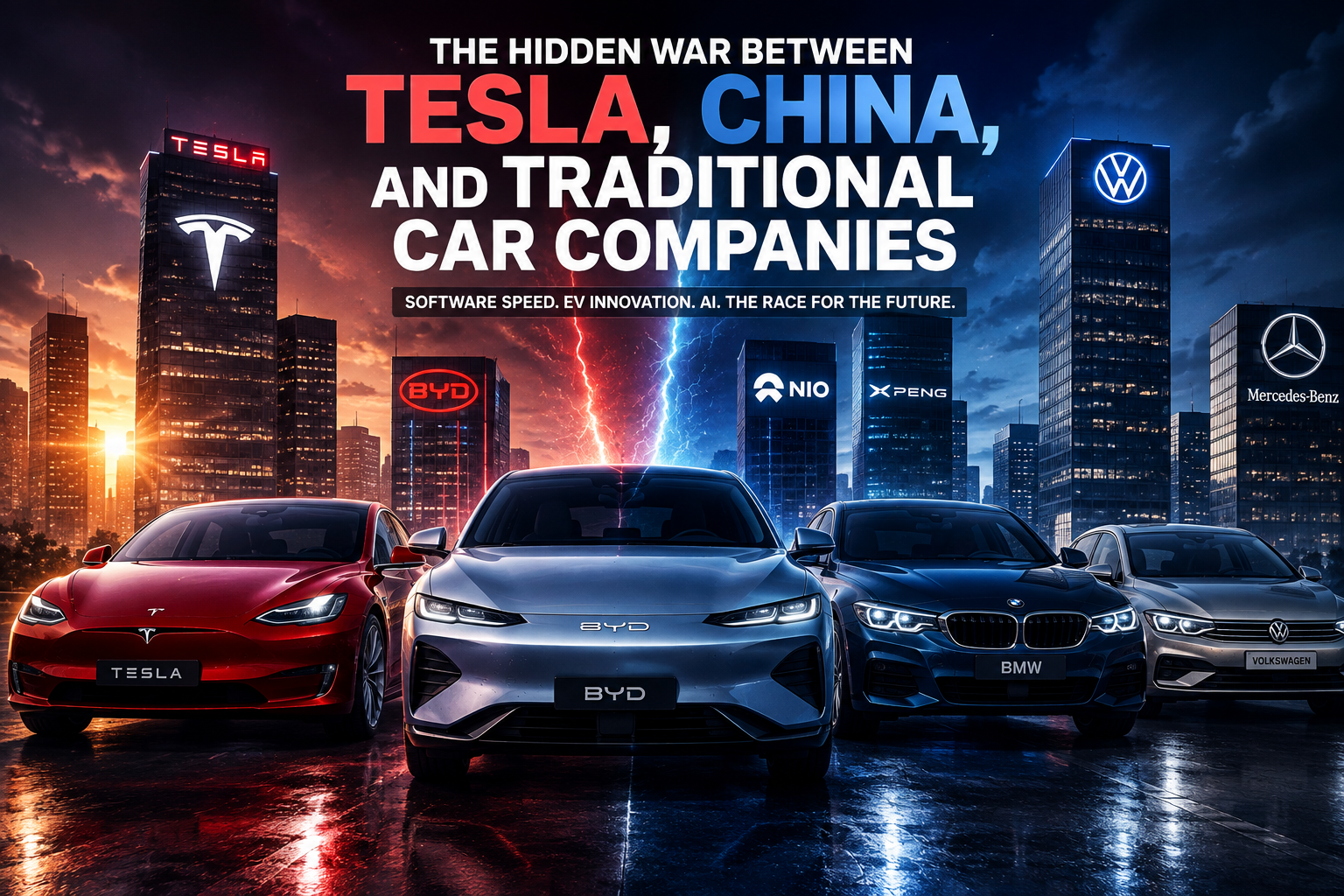
On one side is Tesla, the company that convinced the world an electric car could be desirable, technologically advanced, and profitable.
On another side are China's rapidly expanding EV manufacturers, including BYD, Geely, NIO, XPeng, Xiaomi and others.
And standing between them are the traditional giants — Toyota, Volkswagen, BMW, Mercedes-Benz, Ford, General Motors, Hyundai, Honda and many more — companies with decades of manufacturing experience but a very different way of developing cars.
So the real question isn't simply:
Who makes the best electric car?
The bigger question is:
Who is learning fastest?
Tesla Changed the Rules
Before Tesla became a serious force, most people thought of cars as mechanical products.
You bought one.
You drove it.
You serviced it.
And eventually, you replaced it.
Tesla introduced a different philosophy.
The car could be treated more like a computer.
Software became central to the ownership experience. Features could be improved remotely. The vehicle could collect enormous amounts of information from its sensors. The interface became part of the product itself.
That philosophy influenced almost everyone else.
Suddenly, traditional manufacturers were no longer competing only against other automakers.
They were competing against a technology company.
That distinction matters.
A traditional car company might spend years developing a new model.
A software company is accustomed to releasing improvements continuously.
The automotive industry is now trying to combine both worlds.
Then China Started Moving Even Faster
Here's where the story gets really interesting.
China didn't simply follow the EV revolution.
It built an enormous ecosystem around it.
China has become the world's largest EV manufacturing hub. The International Energy Agency estimates that nearly 75% of electric cars produced globally in 2025 were manufactured in China. Chinese EV exports also reached more than 2.5 million vehicles in 2025.
That scale creates something incredibly powerful:
competition.
Chinese manufacturers aren't operating in a quiet market where one company can take five years to perfect a product.
They're fighting each other constantly.
BYD competes with Geely.
Geely competes with Changan.
NIO competes with XPeng.
New companies appear with surprising speed.
And when dozens of manufacturers are fighting for the same customers, development cycles can become brutally fast.
BYD Is No Longer Just a Cheap-EV Story
For years, many people outside China associated Chinese cars with affordability.
That perception is changing.
BYD has become one of the most important companies in the global EV market, while Chinese brands are increasingly offering vehicles with sophisticated driver assistance, large digital displays, advanced batteries and increasingly polished interiors.
In China's new-energy vehicle market, BYD remained the leading manufacturer in several major months of 2026. In May, for example, it held about 21.8% of China's passenger NEV retail market, according to CPCA data compiled by CnEVPost.
But the interesting part isn't simply the sales number.
It's the speed at which the industry is changing.
A feature that looks futuristic today can become ordinary surprisingly quickly.
The Traditional Automakers Have One Huge Advantage
It would be easy to look at Tesla and Chinese EV companies and assume the old car companies are finished.
That's far too simple.
Toyota, Volkswagen, BMW, Mercedes-Benz, Hyundai, Ford and other established manufacturers possess something startups can't easily manufacture:
experience at enormous scale.
They understand crash testing.
They understand manufacturing.
They understand global supply chains.
They have dealer networks.
They have millions of customers.
And they know how to build vehicles that survive years of real-world use.
That knowledge is extremely valuable.
The problem is that experience can also become a disadvantage when an industry suddenly changes direction.
Imagine being extremely good at building horses at the exact moment everyone starts buying cars.
Your knowledge still matters.
But the rules have changed.
The Real Battle Is Happening Inside the Car
Walk into a modern EV and you'll notice something immediately.
The dashboard looks different.
The controls are increasingly digital.
The screen is larger.
The vehicle may have fewer physical buttons.
The software controls everything from climate settings to navigation.
And underneath that screen is an increasingly complicated network of processors, sensors and cameras.
This is why software development has become such a critical automotive skill.
The next generation of cars isn't simply electric.
It's software-defined.
The vehicle can be updated, monitored and improved through software throughout its life.
That changes the relationship between the manufacturer and the customer.
China Has Another Secret Weapon: Speed
One of the most interesting differences between automotive markets is development speed.
Chinese manufacturers operate in one of the world's most competitive EV markets.
New models appear constantly.
Prices change rapidly.
Technology moves quickly.
Companies have to react.
That pressure can be painful for manufacturers, but it can also accelerate innovation.
The result is a market where consumers can sometimes get features that would have seemed extraordinary only a few years earlier.
This doesn't mean every Chinese EV is better.
It means the pace of competition is becoming difficult for traditional manufacturers to ignore.
And Tesla Isn't Sitting Still
Tesla's position is more complicated than simply being "the EV leader."
It still has enormous brand recognition, a huge global fleet and significant software and AI ambitions.
Its China-made vehicle sales also rebounded strongly in July 2026, rising 37.8% year over year to 93,579 units, including exports from its Shanghai factory.
But Tesla faces an increasingly crowded field.
Its biggest challenge may not be that someone builds a better electric motor.
It may be that competitors become equally good at the things Tesla once made feel special.
Fast charging.
Software.
Digital interiors.
Driver assistance.
Battery technology.
Manufacturing efficiency.
Once competitors catch up, being different becomes much harder.
The Price War Nobody Can Ignore
Electric cars have created another battlefield:
price.
When manufacturers compete aggressively, consumers benefit.
But companies don't necessarily love it.
Lower prices can reduce profit margins.
Chinese manufacturers have enormous production scale, while competition inside China has become intense. That pressure is one reason manufacturers are looking overseas for growth. The IEA reports that Chinese EV exports more than doubled from 2024 to 2025, reaching a record above 2.5 million vehicles.
And now those cars are showing up in more markets.
Chinese EVs accounted for 14.2% of battery-electric vehicle sales in Western Europe during the first five months of 2026, according to recent reporting.
That is no longer a distant trend.
It's becoming a direct challenge to established manufacturers.
Why Traditional Car Companies Can't Simply Copy Tesla
This sounds easy.
Just build an EV.
Add a giant screen.
Install some cameras.
Create an app.
Done.
Except it isn't.
A modern car company has thousands of suppliers, factories, regulations, dealerships, legacy software systems and existing vehicle programs.
Changing one part can affect dozens of others.
A company that has spent decades perfecting gasoline engines cannot transform its entire organization overnight.
This is why the transition can look painfully slow from the outside.
Behind the scenes, enormous organizations are trying to rebuild themselves while continuing to sell millions of vehicles.
The AI Race Could Change Everything
The next phase may be even bigger than the EV race.
It's AI.
Cars are gaining increasingly sophisticated systems for:
Driver assistance
Object recognition
Parking
Voice control
Driver monitoring
Route planning
Predictive maintenance
Personalization
Eventually, the winning car may not be the one with the biggest battery.
It may be the one with the smartest software.
And that changes who the competitors are.
Suddenly, automotive companies aren't only competing with each other.
They're competing with the entire technology ecosystem.
But There Is a Catch
Technology alone doesn't make a great car.
A vehicle can have ten cameras, five screens and hundreds of sensors and still be frustrating to own.
People care about simple things too.
Does it feel good to drive?
Is it comfortable?
Is it reliable?
Can I repair it?
How much does it cost?
What happens when the battery gets old?
Will the software still work ten years from now?
These questions are where traditional automotive expertise remains extremely important.
The future won't necessarily belong to the company with the most technology.
It may belong to the company that combines technology with trust.
So, Who Is Actually Winning?
That's the fascinating part.
There isn't one winner yet.
Tesla helped rewrite the industry's rulebook.
Chinese manufacturers are showing how quickly EV technology and manufacturing can scale.
Traditional automakers still possess enormous engineering, manufacturing and global-market strengths.
And companies such as BYD and Geely are demonstrating that the competitive landscape is much wider than it was a decade ago. Recent Chinese market rankings show just how crowded the new-energy market has become, with Tesla sometimes outside the top positions despite remaining a major global EV brand.
This isn't one company defeating another.
It's an industry being rebuilt in real time.
The Biggest Winner May Be the Driver
There's one part of this competition that deserves more attention.
You.
When companies fight for customers, they have to give people better products.
More range.
Faster charging.
Better software.
Better interiors.
Smarter safety systems.
More features.
Lower prices.
That's the upside of competition.
But there's also a downside.
Cars are becoming increasingly dependent on software.
Features can become subscriptions.
Repairs can become more complicated.
Data privacy becomes more important.
And the difference between owning a car and owning a constantly connected digital product becomes increasingly difficult to define.
The Question Nobody Can Answer Yet
Ten years from now, will we remember Tesla as the company that transformed the automobile?
Or will we look back and realize Tesla was simply the first major chapter of a much larger revolution?
Perhaps the biggest surprise will come from China.
Or perhaps Toyota, Volkswagen, Hyundai, BMW and the other established giants will use their enormous resources to catch up and eventually overtake the newcomers.
There is another possibility.
Maybe there won't be one winner at all.
Instead, the automotive industry could become a permanent technology race where companies constantly leapfrog each other.
One year, Tesla leads.
The next year, BYD introduces something unexpected.
Then another manufacturer responds.
Then someone else finds a better solution.
And the cycle starts again.
Final Thoughts: The Car Industry Will Never Be the Same
The most important thing happening in the automotive world isn't simply the switch from gasoline to electricity.
It's the transformation of the automobile from a mostly mechanical product into a connected technology platform.
Tesla helped make that transformation visible.
Chinese manufacturers are accelerating it through scale, competition and rapid product development.
Traditional automakers are fighting back with decades of engineering knowledge, manufacturing expertise and global reach.
So, has the traditional car industry already lost the technology race?
No.
But it has lost something else:
the luxury of moving slowly.
The rules have changed.
The companies that survive won't necessarily be the oldest, the richest or even the ones with the most famous badges.
They'll be the ones that can learn, adapt and improve faster than everyone else.
And for car enthusiasts, that could make the next decade one of the most exciting periods in automotive history.
Because the real battle isn't about who builds the best car today.
It's about who builds the car everyone else will be trying to copy tomorrow.
Leave a Comment
Your comment will appear after moderation.