Imagine getting into your car after a long day.
You start the engine—or perhaps you simply press a button.
Your phone connects automatically.
The navigation system already knows your usual route.
The seat moves into your preferred position.
Your favorite playlist appears on the screen.
The climate control remembers your temperature.
A small camera is watching the road.
Another sensor may be watching you.
Everything feels convenient.
Almost effortless.
But there is a question most drivers rarely stop to ask:
How much does the car actually know about you?
Because modern vehicles aren't just transportation anymore.
They are connected computers with wheels.
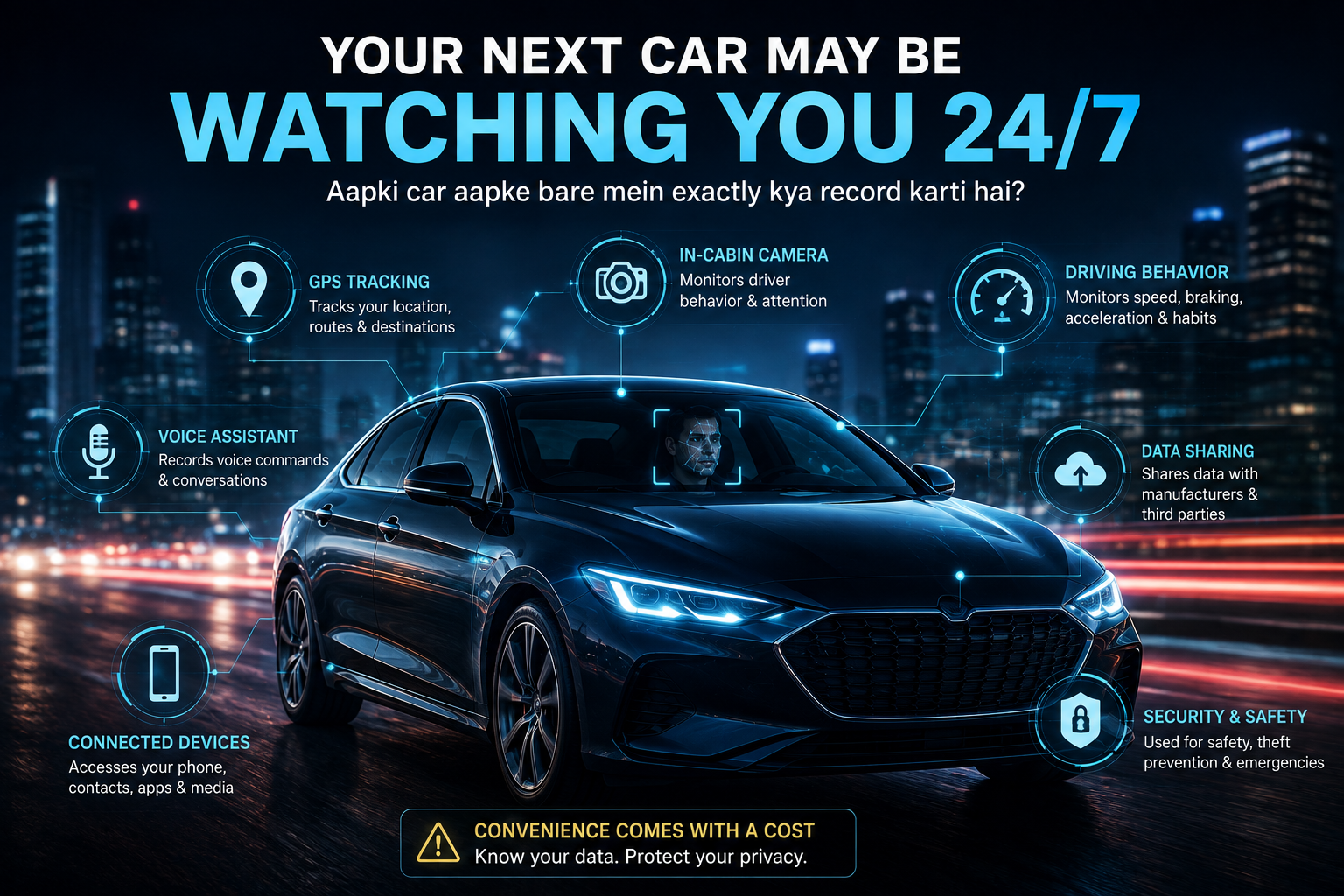
And depending on the vehicle, the technology inside may be capable of collecting information about your location, driving behavior, connected devices, voice interactions, and even what is happening inside the cabin.
That doesn't automatically mean your car is “spying” on you in the way a movie villain would.
Much of this data exists for legitimate reasons—safety, navigation, personalization, theft prevention, emergency assistance, and vehicle maintenance.
The uncomfortable part is something else.
Once your car starts collecting personal information, who else gets access to it?
Your Car Knows Where You Go
GPS is one of the most useful technologies ever added to automobiles.
Without thinking about it, we use it for navigation, traffic updates, finding charging stations, locating restaurants, and remembering where we parked.
But location data can reveal much more than a destination.
A repeated journey can reveal where you live.
Another route might reveal where you work.
A regular evening stop could reveal a gym, a relative's home, or another place you visit frequently.
In other words, your location history can create a surprisingly detailed picture of your life.
The U.S. Federal Trade Commission has specifically described precise vehicle geolocation as sensitive information because persistent location data can reveal intimate details about a person's routines and activities.
That is why connected-car privacy isn't just a technical issue.
It's a personal one.
Then There Are the Cameras
Look around the cabin of a modern car and you'll increasingly find cameras and sensors doing jobs that would have seemed unbelievable a generation ago.
Some systems monitor the road.
Others can monitor the driver.
Driver-monitoring technology can help determine whether someone is paying attention, becoming distracted, or potentially falling asleep.
From a safety perspective, that's incredibly useful.
Imagine a system noticing that your eyes are repeatedly leaving the road.
It could issue a warning before a dangerous situation develops.
That's the good side.
But here's the question that makes people uncomfortable:
What happens to the information collected by those cameras?
Is it processed entirely inside the vehicle?
Is anything uploaded?
How long is it stored?
Who can access it?
Can it be deleted?
Those questions matter because consumers are clearly thinking about them.
Deloitte's 2026 Global Automotive Consumer Study, based on more than 28,500 consumers across 27 countries, found significant concern around sharing connected-vehicle information, particularly data from synced devices, in-cabin cameras, and vehicle location.
So the privacy concern isn't imaginary.
People are noticing.
Your Voice Could Become Vehicle Data Too
“Call Mom.”
“Find the nearest gas station.”
“Turn the temperature down.”
Voice commands are becoming a normal part of driving.
But voice assistants require microphones.
And microphones create another potential category of personal information.
Voice technology generally works by detecting a spoken request and processing it through software. Depending on the system, some processing may occur locally while other services may communicate with remote servers.
The Federal Trade Commission warns that voice assistants can sometimes record audio when they mistakenly interpret something as a wake command, and that voice interactions may be sent to manufacturer servers.
That doesn't mean your car is secretly recording every conversation you have.
But it does mean drivers should understand what their particular system actually does.
The privacy settings aren't just boring legal paperwork.
They can tell you what information is collected, why it is collected, and sometimes how long it is retained.
Your Driving Style Can Become a Data Profile
Here's something even more surprising.
Your car may not need to know what you're saying to learn a lot about you.
It can learn from the way you drive.
Hard braking.
Rapid acceleration.
Speeding.
Late-night driving.
Mileage.
Trip frequency.
Location.
Sudden changes in driving behavior.
Individually, these pieces of information may seem harmless.
Put them together, however, and they can create a detailed driving profile.
A 2025 FTC action against General Motors and OnStar brought this issue into the spotlight. The FTC alleged that precise geolocation and driving-behavior information from millions of vehicles was collected and shared with third parties without adequate disclosure and affirmative consent. The FTC's 2026 finalized order requires greater transparency and consumer choice and restricts certain data sharing.
That case doesn't mean every automaker treats driver data the same way.
It does demonstrate something important:
The data produced by your car can have real-world consequences.
The Smartphone in Your Pocket Makes Things Even More Interesting
Your car might not know much about you by itself.
Then you connect your phone.
Suddenly, the relationship changes.
Bluetooth can connect calls and contacts.
Navigation can access destinations.
Music systems can recognize your preferences.
Apps can communicate with the vehicle.
Some cars allow remote functions through smartphone applications.
Convenience is the whole point.
But when you connect a personal device to a vehicle, you should remember that you're creating another digital connection.
That's why it's a good idea to remove old phones and accounts when you sell or return a vehicle.
The FTC has specifically advised consumers to wipe personal data from connected cars before selling them, much like they would wipe a computer or smartphone.
Your old car shouldn't leave with your digital life still inside it.
The Strange Thing About Modern Cars: They Can Improve After You Buy Them
Remember when buying a car meant the feature set was basically frozen on the day you drove it home?
That idea is disappearing.
Over-the-air updates can modify vehicle software without requiring a dealership visit.
That's great when an update fixes a bug, improves security, or adds useful functionality.
But it also means your relationship with the manufacturer doesn't necessarily end when you drive away from the dealership.
Your vehicle can remain digitally connected for years.
Deloitte's 2026 research found that many consumers see value in software-defined vehicles and regular over-the-air enhancements, while privacy concerns remain significant around connected data.
The car is no longer simply a product.
Increasingly, it's becoming a service.
And services involve data.
So… Is Your Car Actually Watching You?
Technically, the answer depends on what you mean by “watching.”
A camera used for driver monitoring is watching the driver.
A GPS receiver is determining location.
A microphone is listening for voice commands.
Sensors are continuously measuring the vehicle and its surroundings.
But that doesn't necessarily mean someone at a company is sitting in a room watching your camera feed or following your location in real time.
That's an important distinction.
The real issue is data collection and control.
What information does the vehicle generate?
Where does it go?
Who processes it?
Who can access it?
How long is it kept?
Can you turn certain collection off?
Can you delete the information?
Those are much better questions than simply asking whether a car is “spying.”
The Privacy Trade-Off
Here's the uncomfortable reality:
Better technology often requires more information.
Automatic emergency assistance needs to know something happened.
Navigation needs your location.
Driver monitoring needs information about your attention.
Personalized settings need to remember your preferences.
Anti-theft systems may need vehicle location.
Predictive maintenance needs vehicle-health information.
The technology isn't automatically bad.
In many cases, it's genuinely useful.
The problem begins when consumers don't understand the trade-off.
If you're giving a company access to sensitive information, you should know what you're getting in return.
What Consumers Actually Want
Interestingly, drivers aren't rejecting connected technology altogether.
Deloitte's 2026 study found that consumers tend to show the strongest willingness to pay for connected features related to safety and security, including emergency assistance, automatic detection, and anti-theft tracking.
At the same time, data from synced devices, cabin cameras, and vehicle location produces much stronger privacy concerns.
That tells us something important.
People aren't necessarily saying:
“Don't make my car smart.”
They're saying:
“Make my car smart—but don't make my personal information the price.”
That's a very different message.
How to Protect Your Privacy
You don't need to become a cybersecurity expert to make smarter choices.
Before buying a connected car, check its privacy policy and connected-services settings.
Look for information about:
Location collection
Driver-monitoring cameras
Voice assistants
Smartphone data
Data sharing
Insurance-related services
Third-party companies
Data retention
Deletion options
When selling your car, remove your personal accounts, phones, navigation history, and stored information.
Use strong passwords for connected-car apps and enable two-factor authentication when available.
And don't automatically accept every connected service simply because the dealership recommends it.
Take a minute.
Read what you're agreeing to.
The Future Could Be Even More Personal
The cars arriving over the next decade may become dramatically more intelligent.
AI could personalize the cabin based on your preferences.
Cameras could monitor attention more accurately.
Voice assistants could become conversational.
Cars could predict where you're going before you enter the destination.
The vehicle could recognize different family members and automatically adjust seats, mirrors, temperature, music, and navigation.
Imagine entering your car after a stressful day.
The vehicle recognizes you.
It adjusts the lighting.
Your preferred playlist starts.
The temperature changes.
The navigation suggests taking a quieter route home.
It feels almost magical.
But then comes the question:
How much should a machine know before personalization starts feeling like surveillance?
That's a line the automotive industry will have to figure out.
The Real Battle Isn't Technology. It's Trust.
The future car won't simply compete on horsepower, acceleration, range, or fuel economy.
It will compete on trust.
Drivers need to know that the technology designed to protect them isn't quietly creating a detailed digital profile that they don't understand.
Manufacturers, regulators, privacy advocates, and consumers will all have a role to play.
And the companies that explain their data practices clearly may eventually have an advantage over those that hide everything behind pages of legal language.
Because nobody wants to feel like the person who bought the car accidentally agreed to become the product.
Final Thoughts
Your next car may indeed know more about you than any car you've ever owned.
It may know where you go.
It may understand how you drive.
It may recognize your voice.
It may monitor whether you're paying attention.
It may communicate with your phone, the manufacturer's servers, and other connected services.
But that doesn't automatically make the technology frightening.
The real danger is not knowing.
A connected car can save lives, prevent accidents, make driving easier, help recover a stolen vehicle, and provide features that would have sounded like science fiction twenty years ago.
The challenge is making sure convenience doesn't quietly become surveillance.
So the next time you're shopping for a car, don't just ask:
“How fast is it?”
Don't only ask:
“What's the fuel economy?”
And don't stop at:
“How much does it cost?”
Ask one more question:
“What does this car know about me—and who else can know it?”
Because in the future, buying a car may mean buying something more than transportation.
You may also be buying a digital relationship.
And that's something every driver deserves to understand before pressing Start.
Leave a Comment
Your comment will appear after moderation.